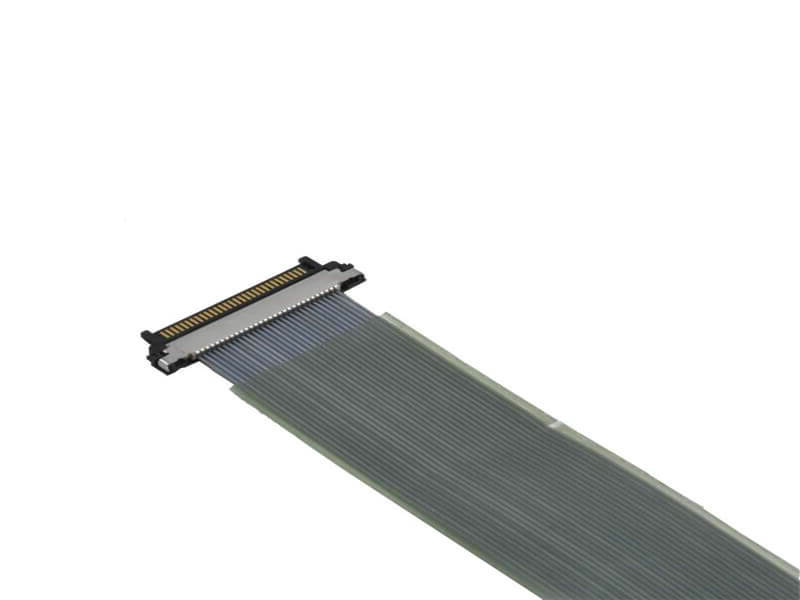
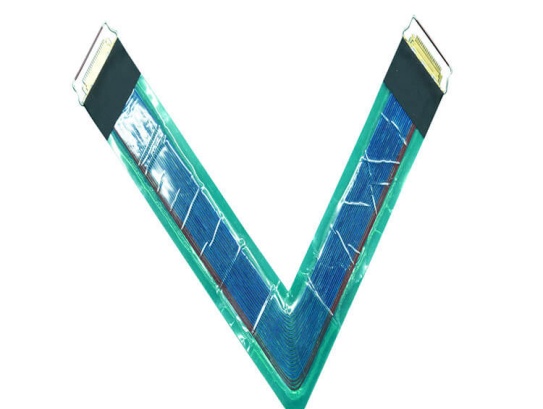
The JAE FI-R series is a family of high-speed, fine-pitch board-to-cable connectors designed for internal serial transmission. It is widely used in applications like LCD/LED displays, medical imaging, industrial cameras, and high-speed test equipment. Common models include FI-RE21S-VF, FI-RE31CL, and FI-RE51S-HF.
JAE FI-R micro coaxial cable connector matchingis the systematic process of selecting compatible FI-R connectors, fine coaxial cables, and PCB layouts. The goal is to ensure the entire interconnect system meets stringent requirements for signal integrity, mechanical reliability, and manufacturability.
Why is FI-R Matching Critical?
- Signal Integrity at High Speeds The FI-R series is engineered for high-speed differential signals (LVDS, TMDS, PCIe). Each contact pair is impedance-controlled to 100 Ω differential. Any mismatch—in the cable, connector, or PCB—can cause signal reflections and integrity issues, especially above 1–3 Gbps.
- Mechanical Reliability FI-R connectors feature a 0.5 mm pitchand a 3.8 mm height, with a mechanical lock to prevent accidental disconnection. Mismatched parts can lead to poor mating, increased wear, or even broken contacts, particularly in high-vibration environments.
- Application-Specific Demands In medical imaging or industrial vision, a failed connection can have severe consequences. Matching ensures the cable assembly can withstand bending, twisting, and long-term use without degrading signal quality.
Key Elements of FI-R Matching
1. Connector-to-Connector Matching
- Series & Family:Ensure you are using components from the JAE FI-R seriesand not a similar-looking series.
- Position Count:The series offers 21, 31, 41, and 51 positions. Mismatched pin counts are physically incompatible.
- Plug/Receptacle:The cable assembly uses a plug(FI-RExxCL), while the PCB uses a receptacle(FI-RExxS-VF/HF).
- Orientation:Choose between vertical (VF)and right-angle (HF)receptacles based on your PCB layout. They share a common footprint.
- Shell & Lock:Verify the presence of a shell for EMI protection and a mechanical lock for secure mating.
2. Connector-to-Cable Matching
- Cable Type:The FI-R series is designed for fine coaxial cableswith extremely small diameters.
- Wire Gauge Compatibility:
- Crimp Plug (Discrete Wire):Accepts 30–36 AWGtwisted pair or discrete wires.
- Solder Plug (Coaxial):Designed for 40 AWGfine coaxial cable.
- Impedance & Loss:For high-speed data (e.g., 3 Gbps+ LVDS), use cables with a differential impedance close to 100 Ωand low insertion loss.
- Shielding & Flexibility:For moving applications, balance shielding effectiveness with cable flexibility (e.g., braided vs. foil shields).
- Environmental Specs:Ensure the cable’s temperature rating (typically –40 °C to +80 °C) meets your application’s requirements.
3. Connector-to-PCB Matching
- Footprint & Keep-Out:Use the exact recommended footprint from the JAE datasheet to avoid impedance discontinuities.
- Differential Pair Routing:Route pairs with 100 Ω differential impedance, maintaining symmetry and minimizing stubs.
- Reference Planes:Provide solid, continuous ground planes adjacent to the differential pairs.
- Via Minimization:Limit the use of vias on critical high-speed pairs to reduce impedance discontinuities and signal reflections.
Step-by-Step FI-R Matching Workflow
- Define System Requirements:Determine your data rate, maximum cable length, and operating environment (temperature, vibration, EMI).
- Select Position Count:Choose the appropriate FI-R receptacle (e.g., FI-RE31S-VF) based on your PCB layout needs.
- Choose Cable Assembly:Select a compatible FI-R plug (e.g., FI-RE31CL) and specify the fine coaxial cable based on your performance and mechanical needs.
- Design PCB Layout:Follow JAE’s recommended footprint and routing guidelines for 100 Ω differential impedance.
- Prototype & Validate:Build initial prototypes and perform signal integrity testing (eye diagrams, TDR) to confirm performance.
- Finalize & Manufacture:Once validated, finalize the BOM and assembly documentation for volume production.
💡 Common Pitfalls to Avoid
- Mixing Series:Do not mix FI-R components with other JAE series or competitors’ parts.
- Ignoring Impedance:Using non-100 Ω cables or poor PCB stackups is a primary cause of signal integrity failure.
- Overbending Cables:Excessive bending near the connector can damage the delicate coax and degrade performance.
- Skipping Validation:Never skip prototyping and SI testing, especially for high-speed or mission-critical designs.
Resources & Further Reading
- Official JAE Resources:Download datasheets and application notes for specific FI-R models (e.g., FI-RE21S-VF, FI-RE31CL) from the JAE website.
- Distributor Websites:Many distributors provide detailed specifications and application guidance for FI-R connectors.