In modern embedded vision, the micro coaxial cableis the critical link that determines image quality, system reliability, and overall product size. As embedded camera systems evolve—from tiny IoT sensors to multi-camera rigs on autonomous robots—designers are moving beyond traditional FPC/FFC cables to micro coaxial solutions for MIPI CSI-2, LVDS, and other high-speed interfaces.
This article explains what makes micro coaxial cable essential, how to choose the right one, and how to avoid common pitfalls when designing with it for embedded camera systems.
Why Micro Coaxial Cable Is Essential
Embedded camera systems, such as those for industrial inspection, robotics, drones, and medical imaging, often use MIPI CSI-2 interfaces with multi-gigabit-per-second data rates. At these speeds, signal integrity is paramount. Micro coaxial cables provide a shielded, controlled-impedance path that maintains signal quality over short to medium distances, outperforming ribbon cables in several key areas:
- High-Speed Signal Integrity: Each micro coax channel is a controlled-impedance differential pair, typically 100 Ω, which minimizes reflections and crosstalk. This is crucial for multi-lane MIPI or LVDS video streams where even small impedance mismatches can cause image artifacts or dropped frames.
- EMI/EMC Performance: The coaxial structure—center conductor, dielectric, shield, and jacket—provides excellent immunity to external noise and prevents the cable itself from radiating interference. This is vital in electrically noisy industrial or robotic environments.
- Miniaturization and Weight Reduction: With outer diameters as small as 0.3–1.0 mm, micro coax cables enable compact, lightweight designs for drones, handheld devices, and medical endoscopes, where every millimeter and gram counts.
- Flexibility and Routing: Despite their small size, these cables are highly flexible and can be routed through tight spaces, bent sharply, or folded, making them ideal for complex, multi-camera layouts in confined chassis.
- Multi-Camera Synchronization: In stereo vision or 360° camera systems, using individual coax pairs for each lane ensures timing and signal integrity are preserved, which is more challenging with wide parallel buses.
Common Interfaces and Signal Types
Micro coaxial cables are used in various high-speed, low-voltage differential signaling (LVDS) applications:
- MIPI CSI-2: The de facto standard for mobile and embedded cameras. A typical 4-lane MIPI link at 1.5 Gbit/s per lane achieves 6 Gbit/s total bandwidth. Micro coax is the preferred interconnect for short-reach camera modules.
- LVDS / Sub-LVDS: Widely used in legacy and industrial vision systems for sensor and camera links, especially where EMI performance is critical.
- GMSL / FPD-Link: For longer distances (up to 10–15 m), these serializer/deserializer (SerDes) systems use a single coax or twisted pair. While technically different, they rely on the same principle of high-frequency coax design.
- Other High-Speed Links: Micro coax is also found in embedded display links (eMIPI, eDP variants) and custom FPGA-to-sensor or sensor-to-processor interconnects.
📏 Cable Length and Performance Limits
The maximum usable length of a micro coaxial cable depends on data rate, number of lanes, cable quality, and the presence of repeaters or equalizers.
- Short-Reach MIPI (On-Board / Module-to-Board): For lengths under 100–200 mm, high-quality micro coax preserves signal integrity well. Some assemblies are specified for up to 750 mm.
- Medium-Reach (Multi-Camera Systems): For 200–500 mm, careful design is required. Use high-quality cables, ensure matched lengths between lanes, and implement solid grounding and shielding practices.
- Long-Reach (>1 m): Standard micro coax is generally not suitable. For these applications, use GMSL/FPD-Link SerDes technology, which is designed for 1–15 m transmission over a single coax.
Structure and Key Parameters
A typical micro coaxial cable consists of:
- Center Conductor: High-precision copper or copper-clad steel wire.
- Dielectric Insulation: Maintains consistent impedance (e.g., 100 Ω differential).
- Shielding: A braided or foil shield to block EMI/RFI.
- Outer Jacket: A protective layer, often with a specific durometer for flexibility.
Key Electrical Parameters:
- Impedance: 100 Ω differential for MIPI/LVDS; 75 Ω for analog video (AHD, CVBS). Mismatched impedance is a common cause of signal issues.
- Attenuation: Signal loss increases with frequency and length. High-quality cables use low-loss dielectrics and conductors to minimize this.
- Return Loss & Crosstalk: Good cables exhibit low return loss and excellent inter-pair isolation, especially in multi-lane bundles.
- Propagation Delay: For multi-camera systems, matching the delay between all lanes is critical to prevent skew and image tearing.
Connectors and Assemblies
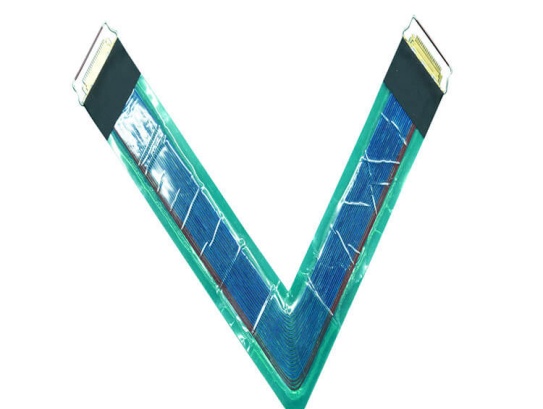
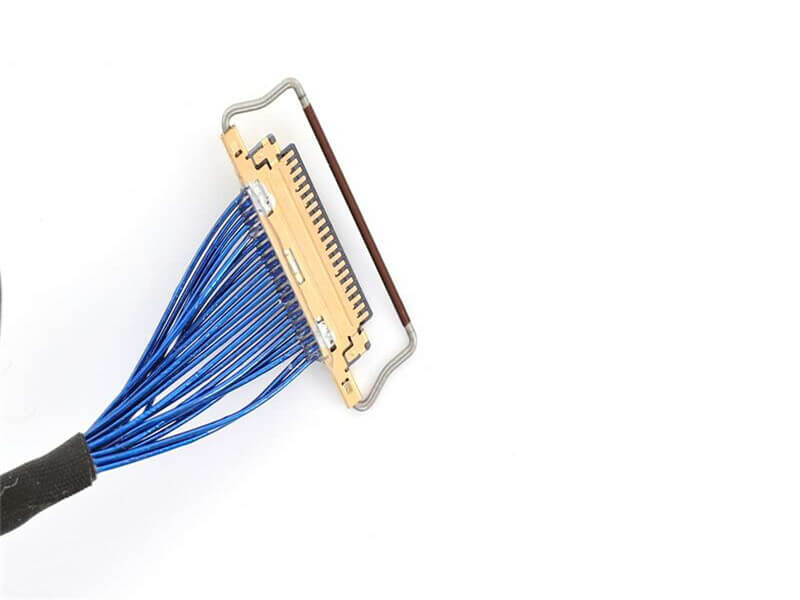
Micro coaxial cable assemblies typically terminate in fine-pitch board-to-board or FPC/FFC-style connectors, such as I-PEX (MHF), Hirose, or JAE. Key considerations include:
- Pitch and Density: Connectors range from 0.4 mm to 1.0 mm pitch, with some supporting 40+ pins in a tiny footprint.
- Mating Cycles: For applications with frequent plug-unplug cycles (e.g., test equipment), choose connectors rated for at least a few dozen cycles.
- Strain Relief: Proper strain relief is essential to prevent the fragile internal coax from being damaged by bending or pulling forces.
- Customization: Many suppliers offer custom assemblies where you can specify length, routing, shielding, and connector orientation.
Design Guidelines for Embedded Camera Systems
- Match Impedance: Ensure the cable, connectors, and PCB traces are all designed for the same differential impedance (usually 100 Ω for MIPI).
- Control Length and Symmetry: Keep all data lanes the same length to within a few millimeters to avoid skew. Minimize stubs and vias in the signal path.
- Plan the Grounding: Use a solid ground plane and provide low-impedance return paths. Connect shields to ground at one end (or both, with caution) to manage EMI.
- Manage Bend Radius: Follow the manufacturer’s specifications for minimum bend radius to avoid damaging the cable or altering its impedance.
- Consider the Environment: For high-vibration or high-temperature environments, select cables with appropriate materials and perform mechanical testing.
- Prototype and Test: Use signal integrity analysis and physical testing to validate your design. Don’t rely solely on datasheets for critical projects.
Practical Examples
- NVIDIA Jetson & MIPI Cameras: Jetson platforms often use micro coax to connect MIPI camera modules. The high-speed MIPI lanes require the excellent signal integrity and EMI resistance of coax, especially in multi-camera or mobile applications.
- Industrial & Robotics: In factory robots, micro coax cables connect cameras in tight spaces, such as inside robotic arms or on moving platforms. Their flexibility and reliability under vibration are key advantages.
- Medical & Wearable Devices: In devices like endoscopes or handheld scanners, the small diameter and flexibility of micro coax allow for highly miniaturized designs without sacrificing image quality.
Micro Coax vs. FPC/FFC vs. Other Options
- FPC/FFC: Cost-effective and easy to use for short, low-speed signals. However, they lack the shielding and impedance control needed for high-speed MIPI, leading to EMI and signal integrity issues.
- Twisted Pair + Shield: Can work for LVDS, but requires careful PCB layout and cable management. Micro coax provides a more controlled and reliable solution.
- GMSL/FPD-Link: The go-to for long distances (1–15 m). Use micro coax for the “last inch” connection to the sensor or processor.
How to Choose the Right Micro Coaxial Cable
- Define Your Requirements: Data rate, number of lanes, maximum length, and operating environment.
- Select the Right Connector: Based on your PCB layout, space constraints, and assembly process.
- Choose a Reputable Supplier: Look for suppliers with experience in high-speed, high-reliability cable assemblies.
- Prototype and Validate: Test your design early to catch any issues with signal integrity, EMI, or mechanical fit.
- Plan for Manufacturing: Ensure the cable can be reliably mass-produced with consistent quality.
Conclusion
In embedded camera systems, the micro coaxial cable is far more than just a wire—it is a critical high-speed interconnect that directly impacts image quality, system reliability, and product size. By understanding its structure, performance limits, and design best practices, you can make informed decisions that lead to successful, robust products.
Whether you are designing a compact IoT camera, a multi-camera robot vision system, or a high-performance medical imaging device, choosing the right micro coaxial cable and connector combination is essential for achieving optimal performance.