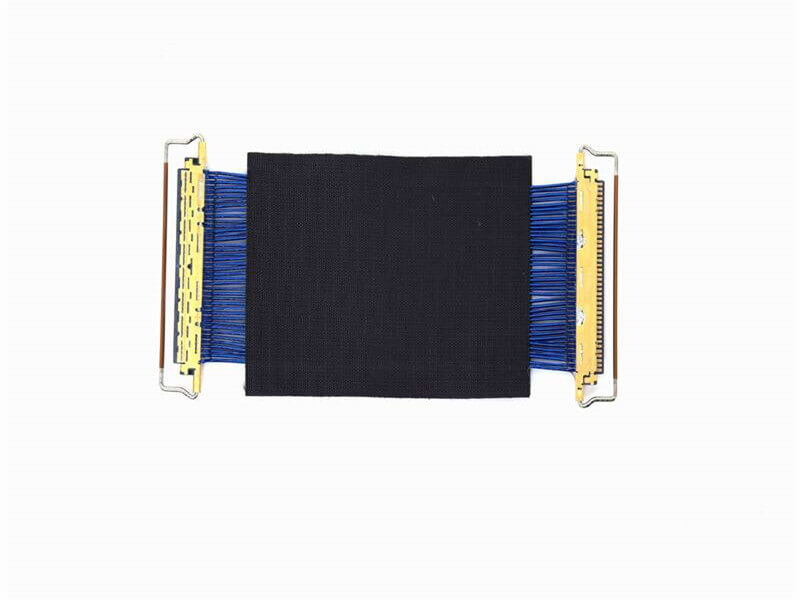
In high-resolution camera modules, displays, and embedded vision systems, the MIPI (Mobile Industry Processor Interface) has become the de facto standard for camera (CSI-2) and display (DSI) interconnects. As resolutions, frame rates, and channel counts increase, the humble micro coaxial cablehas evolved from a simple wiring component into a critical high-speed interconnect that determines image quality, system stability, and EMI compliance.
This article provides an in-depth look at the role of the 90Ω micro coaxial cablein MIPI applications, its electrical and mechanical characteristics, and practical guidelines for selection and design.
Why 90Ω for MIPI?
MIPI D-PHY and C-PHY specifications define the differential impedance of the transmission line, not a single-ended value. The differential impedance of a 90Ω micro coaxial cable is the correct target for a 100Ω differential MIPI pair.
Differential Impedance: The impedance measured between the two conductors of a differential pair.
Single-Ended Impedance: The impedance from one conductor to ground.
For a well-designed differential pair, the relationship is approximately:
Thus, a 100Ω differential target is achieved with a 50Ω single-ended impedance. A 90Ω differential cable is effectively a 45Ω single-ended cable, which is a standard and manufacturable value.
Industry Practice: Many MIPI cable and connector vendors specify their products as “90Ω differential” or “100Ω differential” to match the D-PHY standard. The slight difference between 90Ω and 100Ω is often within the tolerance of the overall channel, especially when considering PCB traces and connector transitions. The key is ensuring the entire channel is impedance-controlled and consistent.
MIPI Speeds and the Need for Micro Coax
MIPI specifications define the following per-lane data rates:
D-PHY: 1.5 Gbps per lane in HS mode (with multi-lane aggregation up to several Gbps total).
C-PHY: Up to 6 Gbps per lane (using a 3-phase encoding scheme).
At these multi-gigabit speeds, even small impedance mismatches, dielectric loss, or crosstalk can cause reflections and degrade the eye diagram, leading to image artifacts like sparkles, flickering, or frame drops.
Why Micro Coax is Essential:
Precise Impedance Control: The coaxial structure (center conductor, dielectric, shield, jacket) allows for tight control over single-ended impedance (typically 45–50Ω), ensuring the differential impedance is close to the 90–100Ω target.
Superior Shielding: Each micro coax pair is individually shielded, drastically reducing crosstalk between adjacent MIPI lanes and protecting against external EMI/RFI.
Controlled Loss: High-frequency dielectric materials (like FEP or PTFE) minimize insertion loss, which is critical for maintaining signal integrity over longer cable lengths.
Mechanical Flexibility: With outer diameters as small as 0.3–0.5 mm, micro coax can be routed through tight spaces and bent without significant performance degradation, unlike stiff FPC/ribbon cables.
Anatomy of a 90Ω Micro Coaxial Cable
A typical 90Ω micro coaxial cable consists of four main layers:
Center Conductor: Usually silver-plated copper (SPC) or bare copper. A larger diameter lowers resistance but increases capacitance, so a balance is needed for the target impedance.
Dielectric Insulation: This layer defines the single-ended impedance. Materials like foamed PTFE or FEP are common for their low dielectric constant (Dk) and low loss. The dielectric thickness is tightly controlled.
Shielding Layer: Typically a combination of a thin aluminum foil and a tinned copper braid. This dual-layer shield provides >90% coverage for excellent EMI protection and low radiation.
Outer Jacket: A flexible material like PVC or polyurethane that protects the cable from mechanical stress and environmental factors. The choice of jacket affects flexibility, temperature range, and flame retardancy.
Matching the 90Ω Micro Coax to MIPI Connectors
The performance of the entire MIPI channel is only as good as its weakest link. The transition from PCB trace to connector to cable must be seamless.
Connector Impedance: Choose connectors explicitly specified for 90Ω or 100Ω differential impedance. Popular MIPI micro-coax connectors include I-PEX (e.g., CABLINE® series), Hirose, JAE, and others. Mismatched connectors can cause significant reflections.
Connector Geometry: The pad size, via stub, and routing on the PCB must be designed to match the connector’s impedance profile. Poor matching at the connector interface is a common cause of signal integrity issues.
Cable-to-Connector Termination: The shield must be securely grounded to the connector’s backshell, and the center conductor must be precisely crimped or soldered. Inconsistent termination can create impedance discontinuities and skew between channels.
Channel Length, Loss Budget, and Practical Limits
The maximum reliable length of a 90Ω micro coaxial cable for MIPI depends on several factors:
Data Rate per Lane: Higher speeds (e.g., 4–6 Gbps) have less tolerance for loss.
Number of Lanes: More lanes increase overall channel loss and crosstalk.
Cable Construction: Materials and shielding quality directly impact loss and EMI performance.
General Guidelines:
For 1.5 Gbps D-PHY, a well-designed micro-coax cable can often reach 150 mmwithout significant signal degradation.
For 2.5–4 Gbps, lengths are typically limited to 50–100 mm.
Some specialized systems, like certain embedded vision platforms, use high-quality micro-coax to achieve up to 1 meterfor 4-lane MIPI, but this requires careful design and often involves trade-offs.
Loss Budget Analysis: Engineers should perform a channel loss budget that accounts for the PCB trace, connector, and cable losses. If the loss at the target frequency is too high, options include:
Shortening the cable.
Reducing the data rate or number of lanes.
Using a lower-loss cable construction.
Adding active components like a repeater or retimer.
Micro Coax vs. FPC/Ribbon Cables for MIPI
While FPC/ribbon cables are cheaper and easier to mass-produce, they fall short for high-performance MIPI applications.
Feature
90Ω Micro Coaxial Cable
FPC / Ribbon Cable
Impedance Control
Excellent and consistent due to coaxial structure.
Difficult to control precisely over long lengths and multiple layers.
EMI/Crosstalk
Excellent, with individual shielding for each pair.
Poor, with significant crosstalk between adjacent conductors.
Bandwidth
Supports multi-gigabit per lane speeds reliably.
Performance degrades rapidly at high frequencies.
Flexibility
Good for tight-radius bends in 3D spaces.
Can fatigue or crack if bent repeatedly in tight radii.
Best For
High-resolution cameras, long MIPI runs, noisy environments.
Very short connections on rigid PCBs where cost is critical.
🛠️ Design and Manufacturing Considerations
PCB Layout: Maintain symmetry in differential pairs and minimize stubs. Ensure the impedance of the PCB traces matches the cable and connector (typically 45–50Ω single-ended).
Grounding: Use a solid ground plane near the high-speed signals. Connect the shields of all micro-coax cables to a common ground point on the PCB to avoid ground loops.
Channel-to-Channel Matching: For multi-lane MIPI, ensure the electrical length of each lane is matched to within a few millimeters to prevent skew, which can cause color misalignment or image tearing.
Manufacturing Quality: The quality of the cable assembly process is paramount. Variations in shielding termination, crimping, and soldering can ruin the impedance match. Work with vendors who have proven experience in high-speed MIPI cable assemblies.
Applications of 90Ω Micro Coax in MIPI Systems
Mobile Devices: Smartphones, tablets, and AR/VR headsets use micro-coax to connect high-resolution cameras and displays to application processors in ultra-compact spaces.
Automotive: In-vehicle cameras for ADAS and surround-view systems rely on shielded micro-coax to maintain signal integrity in harsh electrical environments.
Industrial & Embedded Vision: Machine vision cameras and inspection systems use micro-coax to carry MIPI signals between sensors and processing units, often in robotic or moving assemblies.
Edge AI & SBCs: Platforms like the NVIDIA Jetson Orin use micro-coax to connect multiple MIPI cameras, where signal integrity is critical for AI inference.
Key Takeaways for Your MIPI Design
When specifying a 90Ω micro coaxial cablefor your MIPI interface, focus on the entire channel, not just the cable itself. Ensure that the PCB, connectors, terminations, and cable are all designed and specified as a system to meet your performance targets for data rate, length, and EMI.
The short answer is a resounding yes—coaxial cable assemblies are not only suitable for outdoor applications but have become indispensable in countless outdoor environments, from telecommunications networks to industrial facilities. The...
Coaxial cables are indispensable in a wide range of installations, including telecommunications, security systems, broadcasting, and home entertainment setups. However, the one-size-fits-all approach of standard cable lengths often fall...
In the vast expanse of modern satellite communications, where signals need to traverse incredible distances with utmost precision, micro – coaxial cables have emerged as a crucial component. These cables, smaller in diameter compa...
The short answer is yes—coaxial cable assemblies are indispensable components in aerospace systems, serving as the backbone for reliable signal transmission in aircraft, satellites, and spacecraft. Unlike commercial-grade cables, aerosp...
Introduction:Superconducting magnets are revolutionary workhorses powering devices from MRI scanners revealing our inner workings to powerful particle colliders unlocking the universe’s secrets. At their core lies a critical, yet ...
The relentless push in aerospace towards smaller, faster, and more capable systems – think miniaturized satellites, advanced UAVs, denser avionics bays, and sophisticated sensor arrays – presents an often-overlooked challenge: keeping ...
Repeated bending is the silent killer of micro-coaxial cables. If you design wearables, medical devices, robotics, or any product requiring constant movement, achieving 100,000+ flex cycles is critical. Rigorous testing reveals wh...
In the rapidly evolving fields of medical imaging, industrial non – destructive testing, and scientific research, ultrasound technology has become an indispensable tool. At the heart of these advanced ultrasound systems lies a cri...
In the demanding environment of aerospace engineering, where extreme temperatures, radiation exposure, and reliability are critical, the choice of transmission lines can make or break mission success. Micro-coaxial cables, with their mi...
Micro coaxial cables are the unsung heroes powering our smallest, most advanced electronics – from life-saving medical implants to cutting-edge aerospace systems and the latest smartphones. But their tiny size and delicate construction ...
In industrial, commercial, and even residential settings, protecting electrical cables from physical damage, environmental hazards, and external interference is crucial for ensuring reliable performance and safety. Conduits and raceways...
Coaxial cable assemblies are critical components in signal transmission systems, used widely in industries like telecommunications, aerospace, medical equipment, and industrial automation. Their performance largely depends on shielding—...
Introduction: Precision in Motion Demands Resilience
In the intricate dance of modern electronics, where devices vibrate on factory floors, rumble down highways, endure turbulent flights, or operate within intricate medical instrumen...
Choosing the right insulation material is critical when designing or selecting micro coaxial cables, especially for demanding RF (radio frequency) and microwave applications. Polytetrafluoroethylene (PTFE) and fluorinated ethylene propy...
The world of military technology operates at the bleeding edge, demanding unwavering reliability in the harshest environments. At the heart of countless critical systems – from radar and electronic warfare to satellite communications an...
Introduction
MIPI interfaces—MIPI DSIfor displays and MIPI CSI‑2for cameras—are now the default high‑speed, low‑power links in mobile, embedded, and automotive vision. Designers often encounter the term 90Ω micro coaxial cablewhen ro...
The short answer is yes, coaxial cable assemblies can be used with Wi-Fi routers, but not in the way many people might initially assume. Wi-Fi routers are designed to transmit and receive wireless signals, but they also rely on wired co...
In the intricate ecosystem of medical equipment, where precision and reliability can directly impact patient outcomes, the role of high-performance connectivity solutions cannot be overstated. Our coaxial cables, specifically engineered...
Outdoor cable connections face constant threats from rain, snow, humidity, UV rays, and debris. Without proper protection, these elements can cause signal loss, corrosion, short circuits, or even complete failure. Choosing the right wea...
In the field of modern healthcare, medical imaging equipment stands as a cornerstone of accurate diagnosis and effective treatment. From X-ray machines that reveal bone fractures to high-resolution MRI scanners that map soft tissue stru...
Imagine downloading a full HD movie in a blink, or medical scanners delivering crystal-clear images instantly during life-saving procedures. The relentless surge of data in our world – from streaming services and cloud computing to arti...
Struggling with signal loss, distortion, or bandwidth limitations in your high-frequency applications? You’re not alone. As our world demands faster data transfer, higher resolution video, and more sophisticated wireless communica...
IntroductionHigh-frequency micro-coaxial cables are critical components in modern electronics, enabling reliable signal transmission in applications like telecommunications, medical devices, aerospace systems, and high-speed data networ...
In an era where smart home technology is reshaping modern living, the role of robust and reliable connectivity cannot be overstated. At the heart of seamless smart home integration lies coaxial cable—a time-tested solution that con...
In the rapidly evolving landscape of medical diagnostics, precision, reliability, and miniaturization have become the cornerstones of technological advancement. Among the countless components that power cutting-edge diagnostic equipment...
In today’s tech-driven world, the demand for high-performance micro-coaxial cables is skyrocketing. However, traditional cables often rely on non-recyclable plastics and harmful materials, contributing to environmental pollution. Enter ...
In the harsh and unforgiving environment of space—where extreme temperatures, intense radiation, and vacuum conditions prevail—reliable signal transmission is critical to the success of satellites, space probes, and orbital stations. Mi...
For those in the market for coaxial cables, the warranty period is undoubtedly a crucial factor. It serves as a direct guarantee for your post-purchase rights and interests, providing a safety net when unexpected issues arise with the p...
In the ever-evolving landscape of electronics, the integration of flexible printed circuits (FPCs) with micro-coaxial cable technology has emerged as a game-changer. This innovative combination brings together the best of both worlds, o...
The global micro-coaxial cable market is experiencing dynamic growth, driven by advancements in high-frequency signal transmission and miniaturized electronics. Recent research highlights key trends shaping this niche but critical secto...
As a professional Micro Coaxial Cable Manufacturer, we understand the critical role these cables play in ensuring reliable high-frequency signal transmission. This guide will help you navigate the key considerations for selecting the ri...
Coaxial cables are widely used in home and office setups for transmitting TV signals, internet data, and more. To ensure a neat and efficient connection, wall plates and jacks play a crucial role in coaxial cable termination. This artic...
The demand for micro-coaxial cables is surging, driven by high-speed data transfer in devices like smartphones, medical equipment, automotive sensors, and aerospace systems. Alongside performance, manufacturers and end-users are increas...
For enterprises that rely heavily on coaxial cables, prolonged delivery time can bring about a series of troubles, such as delayed projects and increased costs. However, the recent logistics reform has brought good news to the industry,...
Selecting the right dielectric material for micro coaxial cables is critical for high-frequency performance, reliability, and cost-effectiveness. Polytetrafluoroethylene (PTFE) and Polyethylene (PE) are the two dominant contenders. Unde...
The relentless drive towards smaller, lighter, and more capable military systems places immense pressure on every component – especially the critical infrastructure connecting them: cables. Enter the spotlight: Battlefield-Ready Micro-...
The demanding environments of oil and gas pipelines require technology that doesn’t just perform, but does so safely and reliably, especially under extreme conditions. Among the unsung heroes ensuring data integrity and vital comm...
Micro-coaxial cables are the unsung heroes inside countless modern devices, carrying high-frequency signals for everything from smartphone antennas and medical sensors to satellite communications and military radar. A...
Coaxial cables are the backbone of many communication systems, from home internet setups to industrial networking and broadcasting. Ensuring their signal integrity is crucial for maintaining reliable data transmission, minimizing interf...
In the complex and varied operating environments of modern industries, the performance and durability of coaxial cables are subjected to severe challenges. From extreme temperatures to high humidity, from violent vibrations to corrosive...
OverviewMicro-Coax for HD Video is a cutting-edge coaxial cable engineered to deliver uncompromised high-definition video quality across professional and industrial applications. Designed for reliability, precision, and versatility,.
Micro Coaxial Cable: High-Quality Solutions for Precision Applications
Micro coaxial cables are essential components in high-performance electronic applications, providing reliable signal transmission in compact and flexible designs. A.
Contact Us Micro Coaxial Cable factory-(FRS).
Feel free to reach out to us for any inquiries or orders