What Is a Micro Coaxial Cable for 4K/8K Display Module and How Does It Work - Micro Coaxial Cable factory-(FRS)
Micro Coaxial Cable factory-(FRS)
INFO
Introduction
Modern high‑resolution displays push video interfaces to their limits. To deliver 4K@120Hz, 8K@60Hz, 10‑bit/12‑bitcolor, and HDRwith minimal artifacts, display modules require interconnects that combine very high bandwidth, tight impedance control, and robust EMI immunityin ultra‑compact form factors. Micro coaxial cable—with typical diameters around 0.2–1.32 mm—is purpose‑built for this role. It is widely used inside VR headsets, smartphones, tablets, notebooks, medical imaging, and automotive displays, where space is at a premium and signal integrity is non‑negotiable. In practical terms, 4K/8K video places extreme demands: for example, 4K@60Hz ≈ 12 Gbps, while 8K@60Hz can reach ≈ 48 Gbpsdepending on chroma sampling and compression. Micro coax meets these needs by offering high‑frequency performance, low attenuation, and excellent shielding in miniature assemblies.
Structure and Working Principle
A micro coaxial cable is a miniature version of coax, engineered to carry high‑speed differential signals with minimal loss and crosstalk. Its cross‑section typically includes:
Center conductor: high‑conductivity copper or copper alloy, often finely stranded for flexibility.
Dielectric: low‑loss insulation such as PEor PFA, selected for stable dielectric constant (εr)and low loss tangent to reduce signal attenuation at high frequencies.
Shielding: a combination of aluminum foiland tinned copper braidprovides high shielding effectiveness against EMI/RFI; coverage can exceed 90%in quality designs.
Jacket: flexible materials like PVCor PFAprotect the core and enable reliable flex life.
The principle is simple yet demanding: maintain a precise characteristic impedance(commonly 100 Ω differential) end‑to‑end, minimize return lossand insertion loss, and suppress skewacross all conductors. In a 4K/8K display module, micro coax assemblies route high‑speed video lanes from the timing controller (TCON) to the panel, often through tight bends and narrow channels, while preserving eye diagrams and minimizing jitter.
Why Micro Coax Excels in 4K/8K Display Modules
High bandwidth and low loss: Designed for multi‑gigabit per second links, micro coax supports the data rates required by 4K/8Kformats with low frequency‑dependent loss, preserving edge sharpness and color detail. Typical designs target 6–12+ GHzusable bandwidth depending on construction.
EMI resistance and shielding integrity: The coaxial geometry and dual‑layer shielding (foil + braid) suppress external interference and crosstalk, critical in dense, high‑speed display systems.
Miniaturization and flexibility: With outer diameters as small as ≈0.3 mm, micro coax enables ultra‑thin, lightweight links for edge‑to‑edgedisplays and foldable devices, where bending and torsion are routine.
Controlled impedance and skew: Tight manufacturing tolerances and consistent dielectric properties keep differential pairs matched, reducing intra‑pair and inter‑pair skew for stable images at high resolutions and refresh rates.
Proven in demanding applications: From VR headsetsto medical imaging, micro coax balances mechanical and electrical demands better than most alternative interconnects in constrained spaces.
Common Use Cases and Interfaces
Flat‑panel displays and modules: Micro coax assemblies are widely used to connect LCD/AMOLEDpanels to driver/TCON boards in tablets, notebooks, and monitors, where thin, shielded links are essential for image quality and reliability.
Wearable and immersive devices: In VR/AR headsets, micro coax routes high‑resolution video with minimal weight and bulk, improving comfort and image stability.
Mobile and portable electronics: Smartphones and cameras use micro coax for camera modulesand high‑speed display links, leveraging its small size and robust EMI performance.
Medical and industrial imaging: Portable ultrasound and test gear rely on micro coax to carry high‑frequency image data in compact, interference‑prone environments.
Connector Ecosystem and Typical Configurations
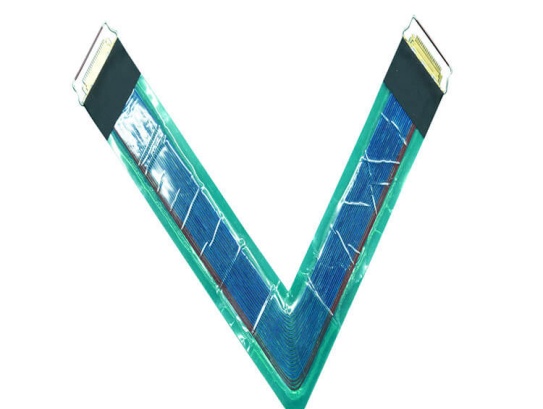
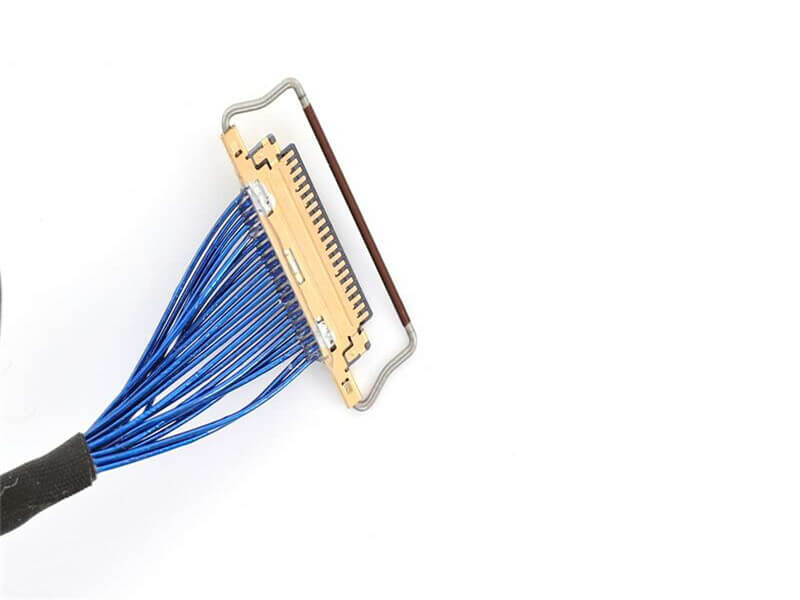
Micro coax is typically terminated with miniature board‑to‑board or FPC‑style connectors that match the pitch and density of the display module. A representative example is the I‑PEX 20497‑026T‑30micro coax connector family, featuring:
0.3 mm pitchand up to 30 pins(with variants offering 26/32/40/50pins)
Low‑profile, high‑densityform factor for space‑constrained designs
Support for high‑speeddifferential signaling in VR/AR, smart devices, and embedded displays
These connectors are designed to mate with micro coax cables of precise impedance and shielding, ensuring that the electrical performance of the cable assembly is preserved through the connector interface.
Design Considerations for 4K/8K Performance
Impedance control and consistency: Target 100 Ω differentialwith tight tolerance; variations cause reflections and eye‑diagram closure.
Shielding strategy: Use dual‑shield (foil + braid)or higher‑coverage constructions to suppress EMI and maintain signal integrity in noisy environments.
Bend radius and flex life: Define allowable bend radiusand flex cyclesearly; tighter bends increase loss and risk of mechanical fatigue.
Length budgeting: Keep high‑speed micro coax runs as short as practical. In many short‑reach display modules, lengths of about 0.5–3 mare common for best results, though this varies by design and data rate.
Connector and PCB interface: Ensure coplanarity, press‑fit integrity, and via/stackupdesign support the controlled impedance and minimize stub length at the connector footprint.
Manufacturing and process control: Use laser stripping, precision crimping/termination, and controlled soldering to avoid impedance discontinuities and shield damage.
Micro Coax vs. Alternative Interconnects
Aspect
Micro Coaxial Cable
FPC/FFC
Typical HDMI/DP Cable
Size/weight
Very small OD (≈0.2–1.32 mm); excellent for tight spaces
Thin but larger in bulk than micro coax
Larger OD; not for internal dense routing
Bandwidth/speed
Supports multi‑Gbps to high‑GHz links for 4K/8K
Limited at high speeds; more skew
Supports up to 48 Gbpsin HDMI 2.1/DP 1.4
EMI performance
Excellent shielding; low crosstalk
Moderate; relies on overall shielding
Excellent in quality cables; not for internal routing
Flex life
Good for dynamic flex (with proper design)
Good for static bends
Not applicable
Typical use
Inside displays, modules, cameras, wearables
Display modules, low‑speed links
External device connections
For internal 4K/8K display links where space, EMI, and high‑speed integrity are critical, micro coax is often the optimal choice.
Practical Example of 8K‑Capable Coaxial HDMI
In the external cable world, coaxial implementations of HDMI 2.1demonstrate what is possible at the system level: cables as short as ≈60 cmwith OD ≈ 2.5 mmsupport 8K@60Hz / 4K@120Hz / 48 Gbps, Dynamic HDR, and eARC, with dual‑layer shielding and compliance for professional video gear. These examples highlight how coaxial design principles scale to very high data rates in compact, flexible formats.
Troubleshooting and Validation
Eye diagram and BER: Validate compliance with interface specifications (e.g., HDMI 2.1/DP 1.4 FEC eye masks) under worst‑case conditions.
Return loss and insertion loss: Measure across the operating frequency band to confirm impedance control and acceptable loss budgets.
Shielding effectiveness: Perform EMI/EMC pre‑compliance to ensure micro coax shielding performs in real environments.
Mechanical stress: Audit bend radius, torsion, and connector strain relief; re‑qualify after any mechanical design changes.
Signal and image quality: Check for sparkles, banding, or intermittent dropouts under motion and EMI sources.
Future Trends and What to Watch
Higher resolutions and refresh rates: Emerging formats will continue to push per‑lane data rates; expect tighter impedance control and lower‑loss dielectrics.
Miniaturization and integration: Connector pitches will shrink further, with more integration (e.g., embedded passives, better strain relief).
Materials innovation: Advanced conductors, low‑k dielectrics, and improved shielding will further extend reach and reliability.
Simulation‑driven design: Increased use of EMI/Signal Integritysimulation to optimize geometry before prototyping.
Sustainable manufacturing: Lead‑free processes, halogen‑free jackets, and recyclable materials will become more common.
Conclusion
For 4K/8K display modules, micro coaxial cable is the high‑performance, miniaturized interconnect that makes stunning visuals possible in impossibly tight spaces. By combining precise impedance, excellent shielding, and mechanical flexibility, micro coax supports the multi‑gigabit, high‑frequency demands of modern video while enabling thinner, lighter, and more reliable devices. Whether in a VR headset, a foldable tablet, or a high‑end monitor, understanding how micro coax works—and how to design with it—is essential for delivering flawless images at the cutting edge of display technology.
Meta Description: Explore the chemistry behind PTFE and FEP—materials that make micro coax ideal for 40GHz applications.Article Content:Why Fluoropolymers?Low Dielectric Loss: PTFE’s εᵣ=2.1 vs. PVC’s εᵣ=3.0 reduces signal attenua...
For B2B buyers in 5G, aerospace, industrial IoT, and medical device industries, finding a reliable micro coaxial cable factory is more than a procurement task—it’s a critical step to avoiding costly project delays, signal integrity fail...
Coaxial cables are the unsung heroes of modern connectivity, powering everything from home televisions and internet routers to security cameras and satellite systems. Their unique design—featuring a central conductor, insulating layer, ...
Micro coaxial cables – those incredibly thin, shielded cables found inside your smartphone, VR headset, medical devices, drones, and high-speed electronics – carry critical signals. But connecting them properly (termination) is essentia...
In the realm of in-wall cable installation, having the right tools can make a world of difference between a smooth, efficient process and a frustrating, time-consuming ordeal. Wall fish tools, specifically designed for navigating the ti...
Coaxial cables are vital for transmitting high-frequency signals in various applications, from home TV setups to professional communication systems. Proper maintenance and care can significantly extend their lifespan, ensure consistent ...
5G networks, especially those operating at higher frequencies (mmWave), place extreme demands on the cabling connecting antennas, radios, and active equipment. Choosing the right micro coaxial cable is critical for performance, reliabil...
In modern embedded vision, the micro coaxial cableis the critical link that determines image quality, system reliability, and overall product size. As embedded camera systems evolve—from tiny IoT sensors to multi-camera rigs on autonomo...
Selecting the right coaxial cable assemblies is critical for optimizing the performance, reliability, and longevity of radio systems. Whether for amateur radio, commercial communication, or industrial wireless applications, suboptimal c...
The short answer is yes—coaxial cable assemblies are indispensable components in aerospace systems, serving as the backbone for reliable signal transmission in aircraft, satellites, and spacecraft. Unlike commercial-grade cables, aerosp...
Coaxial cable assemblies are critical components in signal transmission systems, used widely in industries like telecommunications, aerospace, medical equipment, and industrial automation. Their performance largely depends on shielding—...
The global coaxial cable market has emerged as a critical pillar of the telecommunications, media, and industrial connectivity ecosystems. As high-speed data transmission, 5G network deployment, and 4K/8K video streaming become mainstre...
In the era of miniaturized electronics and high-speed data transmission, micro coaxial cables have emerged as a critical component for applications requiring reliable signal integrity in compact spaces. These cables are a specialized ...
Introduction
In an era of rapid digital transformation, coaxial cables remain a critical component of global communication infrastructure. As we navigate through 2025, the coaxial cable market is experiencing significant dynamics dri...
In today’s world of shrinking electronics and high-speed data transfer, micro coaxial cables play a vital role. But what exactly are they, and how do they work? Whether you’re troubleshooting a device, designing a circuit, or just...
Choosing the optimal cable for high-frequency devices is critical to ensuring signal integrity, minimizing losses, and achieving reliable performance in applications ranging from 5G base stations to radar systems and medical imaging. Wi...
There is no fixed weight for standard coaxial cable assemblies, as it is determined by multiple key factors. Understanding these factors and practical weight references is crucial for engineers, purchasers, and anyone involved in select...
In the realm of wireless communication, where data speeds, signal integrity, and network reliability are paramount, coaxial cable assemblies stand as unsung heroes. These specialized components serve as the critical link between antenna...
Autonomous drones have revolutionized industries ranging from aerial photography and agriculture to logistics and industrial inspection. Behind their seamless operation lies a network of critical components, and micro-coaxial cables sta...
Finding reliable signal transmission cables for hot environments like engine compartments, industrial machinery, or aerospace systems can be a major headache. Standard cables degrade, signals falter, and equipment fails prematurely. Tha...
In an era defined by rapid technological advancements and insatiable demand for high-speed connectivity, the coaxial cable production sector is undergoing a transformative shift. As industries ranging from telecommunications to aerospac...
In the high-stakes world of medical training, simulation technology bridges the gap between theory and practice. From intricate surgical simulators to high-fidelity ultrasound trainers, these platforms demand unparalleled accuracy and r...
Introduction
In high-speed digital communications and RF applications, signal degradation is a critical challenge. Micro-coaxial materials have emerged as a game-changer, minimizing signal loss and preserving data integrity. This art...
As the backbone of modern communication infrastructure, coaxial cables are undergoing a significant transformation driven by global environmental regulations and technological innovations. The promotion of eco-friendly materials in coax...
Meta Description: Learn how to calculate the velocity factor in micro-coaxial cables step-by-step. Improve signal integrity and optimize high-frequency designs with this essential guide.
Introduction
Velocity factor (VF)...
Introduction: The Unseen Backbone of Ultra-High Definition
As we transition from the crisp clarity of 4K to the immersive hyper-realism of 8K, the engineering challenges behind the screen become exponentially complex. We often focus ...
Modern vehicles are evolving into complex networks of sensors and high-speed data links. At the heart of this transformation is the anti-interference micro coaxial cable, a critical component for ensuring the reliable operation of Advan...
In the realm of communication and electronics, coaxial cables stand as indispensable components, with their quality directly impacting the performance of entire systems. Today, a groundbreaking development has emerged: the quality compl...
The Challenge with Traditional Micro-Coaxial Connectors
Micro-coaxial cables (often called “micro-coax”) are essential for high-frequency signal transmission in electronics, medical devices, and telecommunications. Howeve...
In the era of smart manufacturing, industrial automation systems demand components that balance miniaturization, high performance, and durability. Micro-coaxial cables (often abbreviated as micro-coax) have emerged as a critical solutio...
Coaxial cables are a fundamental component in modern communication systems, widely used in applications ranging from television broadcasting to computer networking. The model numbers assigned to coaxial cables are not arbitrary; they en...
As a professional Micro Coaxial Cable Manufacturer, we provide high-performance micro coaxial cable and cable assembly solutions. We offer comprehensive OEM/ODM services, supporting custom diameters, shielding structures, impedance, and...
Coaxial cables are indispensable components in numerous systems, ranging from communication networks to home entertainment setups, as they play a vital role in transmitting signals stably and efficiently. To ensure their long-term relia...
The question of whether coaxial cable assemblies can be used in high-pressure environments is a critical one for industries ranging from oil and gas to marine exploration, aerospace, and industrial manufacturing. The short answer is yes...
Structural Advantages for Medical UseThe core architecture of micro-coaxial cables—comprising a central conductor, dielectric insulation, shielding layer, and protective jacket—is optimized for medical environments:
Miniaturizati...
In the rapidly evolving landscape of high‑frequency signal transmission, the micro coaxial cable has emerged as a critical component for industries that demand precision, reliability, and miniaturization. From the depths of aerospace sy...
In the ever – evolving landscape of traffic management systems, the role of reliable communication infrastructure cannot be overstated. Coaxial cable has emerged as a crucial component in enabling the seamless operation of various...
If you’re working with RF (radio frequency) systems, antennas, or small-scale electronics, chances are you’ve encountered RG-174 micro-coaxial cables. These thin, flexible cables are popular for their low loss and durability in tight s...
In the dynamic world of modern manufacturing, multi-robot assembly lines represent the pinnacle of efficiency, speed, and precision. These complex systems, where multiple robotic arms collaborate seamlessly, demand flawless communicatio...
IntroductionThe High-Temperature Resistant Micro-Coaxial Cable is a cutting-edge connectivity solution engineered to deliver exceptional performance in extreme thermal environments. Combining precision engineering with advanced mate.
Overview of I-PEX Micro Coaxial Cable Connectors
I-PEX is a global leader in micro coaxial cable solutions, specializing in high-performance IPEX micro coax connectors and micro coaxial cable assemblies. These products are designed for.
Contact Us Micro Coaxial Cable factory-(FRS).
Feel free to reach out to us for any inquiries or orders