Micro-Coaxial Cables: The Unsung Heroes in Your EV’s Battery Monitoring System - Micro Coaxial Cable factory-(FRS)
Micro Coaxial Cable factory-(FRS)
INFO
Electric Vehicles (EVs) promise a cleaner, quieter future, but their complex high-voltage battery packs require constant, precise monitoring to ensure safety, performance, and longevity. At the heart of this critical task lies the Battery Management System (BMS), and a key enabler for its accuracy and reliability are Micro-Coaxial Cables. Let’s explore why these tiny cables are so vital.
What Does the BMS Need to Do?
Think of the BMS as the brain of the battery pack. Its primary job is to continuously monitor hundreds or even thousands of individual battery cells. It needs precise measurements, constantly checking:
Cell Voltage: Even tiny differences in voltage between cells can indicate imbalance or potential failure.
Temperature: Cells must operate within a safe range; overheating is a major safety risk.
Current Flow: Measuring current in and out is crucial for calculating charge level (State of Charge) and overall health (State of Health).
Why Are These Measurements So Tricky?
The environment inside an EV battery pack is challenging:
High Voltage: Packs operate at 400V, 800V, or even higher. Nearby cables must resist electrical interference from these voltages.
Electromagnetic Interference (EMI): Motors, inverters, DC-DC converters, and even the flow of high current itself generate significant electrical “noise.” This noise can distort sensitive measurement signals.
Vibration & Harshness: Cars move, roads are bumpy, engines and motors vibrate.
Temperature Extremes: Battery packs experience significant temperature swings during operation and charging.
Space Constraints: Packing thousands of cells densely means very little space for wiring.
Enter the Micro-Coaxial Cable: The Solution for Precision
This is where micro-coaxial cables shine. Their unique design addresses the BMS’s toughest challenges:
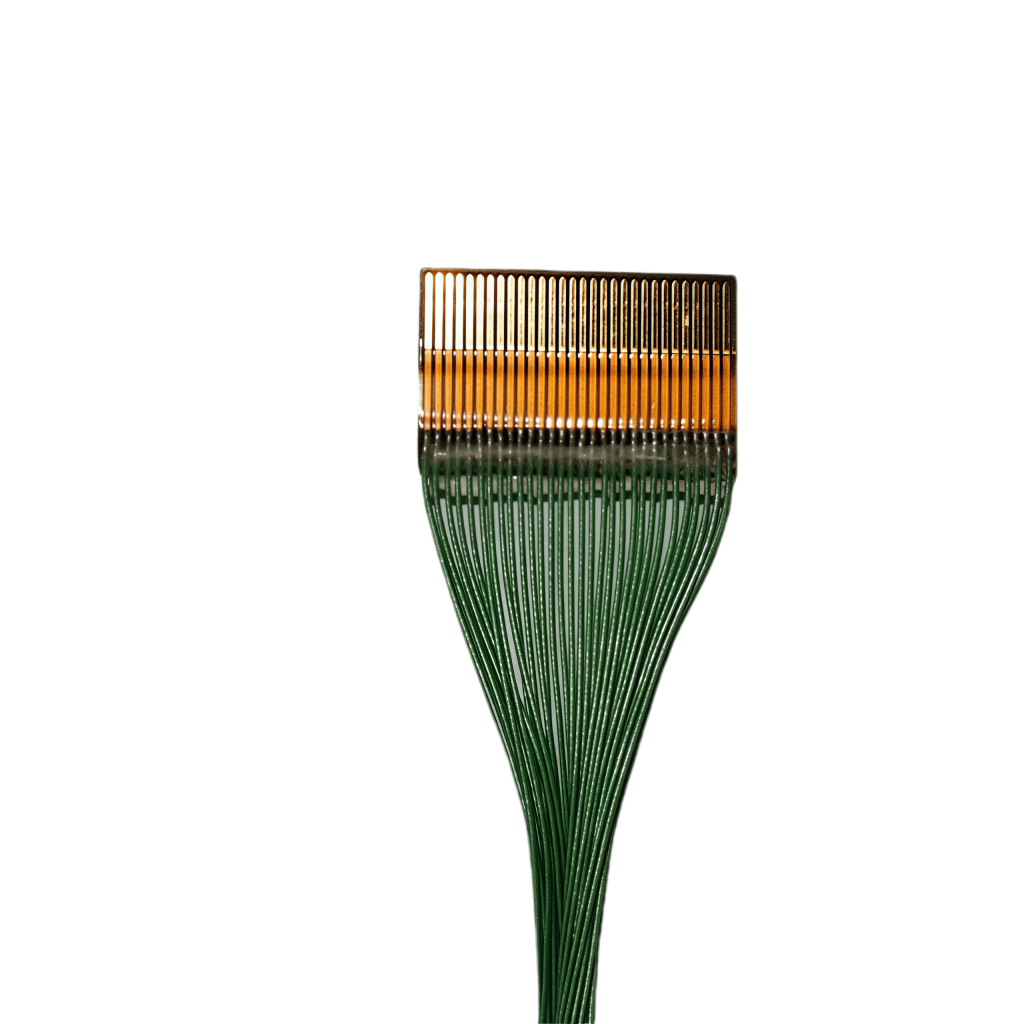
Superior EMI Shielding: This is the primary advantage. Coaxial cables have a central conductor surrounded by insulation, which is then completely encased within a cylindrical conductive shield (usually braided metal), and finally an outer jacket.
How it Works: Any external electromagnetic noise hits the outer conductive shield first. Because of principles like the Faraday cage effect, this shield absorbs or reflects the noise before it can ever reach the delicate voltage or temperature signal traveling along the inner conductor. The signal inside remains pure and uncorrupted.
Accurate Signal Transmission: By eliminating noise and interference (Cross-Talk from nearby wires, EMI from power systems), micro-coax ensures the tiny voltage measurements read by the BMS sensors at each cell are faithfully transmitted back to the central BMS controller. A difference of millivolts matters significantly for balancing and safety.
Robustness in Harsh Environments:
Vibration Resistance: Their inherent structure and high-quality materials (like specialized polymers for insulation and jackets) make them resistant to fatigue from constant vibration.
Temperature Resistance: They are engineered to handle the thermal extremes (-40°C to 150°C+ is common) inside battery packs without degrading electrical properties or physical integrity.
Chemical Resistance: The outer jacket protects against automotive fluids and potential electrolyte exposure.
Space Efficiency (“Micro”): As the name implies, these cables have a very small diameter (often less than 2mm), allowing them to be routed through the tight spaces between densely packed battery modules and cells without adding bulk or compromising pack design.
Key Applications Inside the Battery Pack
Specifically, micro-coaxial cables are typically used for:
Cell Voltage Tap Wiring: Connecting individual cell terminals or groups of cells to the BMS monitoring circuits. This is where accurate voltage reading is paramount and the EMI environment is worst.
Temperature Sensor Wiring: Connecting thermistors or other temperature sensors within the modules to the BMS.
Why Not Regular Wires?
While cheaper, standard wires or even twisted pairs lack the comprehensive shielding of coax.
They are far more susceptible to EMI pickup, leading to inaccurate readings.
Inaccurate readings due to noise can cause the BMS to make wrong decisions about charging, discharging, or balancing, potentially impacting safety and performance.
They generally offer less protection against vibration fatigue in the long term.
In Conclusion: Essential for Safety and Performance
Micro-coaxial cables might be small components, but their role in an EV’s Battery Monitoring System is enormous. By providing unparalleled EMI shielding, ensuring signal integrity for critical voltage and temperature measurements, and offering robustness in a harsh automotive environment, they are fundamental to the safe, efficient, and reliable operation of every modern electric vehicle. They help ensure that the BMS “brain” receives accurate information, enabling it to protect your battery pack and your vehicle effectively. When it comes to the sensitive electronics monitoring high-voltage batteries, micro-coax isn’t just an option; it’s an essential requirement.
Choosing the right micro coax cable isn’t just about specs; it’s about mission success in critical applications. Whether it’s life-saving medical equipment, flight-critical avionics, precision test systems, or secure m...
Coaxial cables and microstrip lines are two fundamental transmission line structures widely used in electronics and telecommunications. While both serve to transmit high-frequency signals, they differ significantly in design, performanc...
Micro coaxial cables are widely used in electronics, telecommunications, and high-frequency applications due to their compact size and reliable signal transmission. However, improperly terminating these cables can lead to signal loss, i...
AbstractCoaxial cables are a cornerstone of modern communication systems, but their design and functionality differ significantly from other cable types such as twisted-pair, fiber-optic, and ribbon cables.
1.IntroductionCables serv...
Introduction
Industrial cable assemblies are critical components in aerospace, automotive, oil/gas, and military applications, where they must withstand extreme temperatures (-60°C to +200°C). Rigorous testing ensures reliability, sa...
The question of whether coaxial cable assemblies can be used in high-temperature settings is a critical one for industries ranging from aerospace and automotive to industrial manufacturing and energy exploration. The short answer is yes...
Underground installation of communication and signal transmission cables is a common practice in many industries, from telecommunications and broadcasting to industrial automation and security systems. However, choosing the right cable ...
In modern embedded vision, the micro coaxial cableis the critical link that determines image quality, system reliability, and overall product size. As embedded camera systems evolve—from tiny IoT sensors to multi-camera rigs on autonomo...
Coaxial cable assemblies are the backbone of modern connectivity, enabling the reliable transmission of radio frequency (RF), microwave, and high-frequency signals across industries ranging from telecommunications and aerospace to medic...
The ease of routing coaxial cable assemblies in tight spaces depends not on a simple “yes” or “no,” but on design characteristics of the assemblies and routing strategies adopted. For users dealing with compact e...
In the relentless pursuit of faster data transfer, higher bandwidth, and more efficient power delivery within complex systems, a revolutionary solution is gaining significant traction: hybrid cables. These innovative cables ingeniously...
Soldering micro-coaxial cables – those tiny cables used for high-frequency signals in devices like smartphones, cameras, and RF equipment – can be intimidating. Their small size and delicate structure demand precision and the right appr...
The short answer is yes, coaxial cable assemblies can be recycled after use—but the process requires careful handling due to their composite structure. As the world grapples with the growing problem of electronic waste (e-waste), recycl...
Imagine lying perfectly still in an MRI scanner, hoping for a quick, clear diagnosis. What determines if that crucial image reveals the subtle details needed? Surprisingly, a complex network of tiny, advanced micro-coaxial cables ...
Why Industrial-Grade Coaxial Cables Matter
Industrial environments demand cables that withstand extreme conditions – from factory floors to outdoor installations. Standard coaxial cables often fail under constant vibration, tem...
Micro coaxial cables are the lifelines of modern electronics, transmitting critical signals in devices from medical implants to aerospace systems and industrial robots. But place them near motors, power lines, wireless transmitters, or ...
Meta Description: Fix your micro coax problems! Learn how to resolve VSWR spikes, solder fractures, and shield corrosion.
Article Content:Common Failures & Solutions
High VSWR at 20GHz:Cause: Improper SMA connector so...
Overview and definition
Ultra-fine micro coaxial cable with a nominal 0.25 mm outer diameter (OD)is a miniature coaxial interconnect built to carry high‑speed, high‑frequency signals in extremely space‑constrained environments. It pr...
Finding reliable signal transmission cables for hot environments like engine compartments, industrial machinery, or aerospace systems can be a major headache. Standard cables degrade, signals falter, and equipment fails prematurely. Tha...
Industrial control systems (ICS) are the backbone of modern manufacturing, energy, transportation, and infrastructure sectors, relying heavily on stable and reliable signal transmission to ensure operational efficiency and safety. Among...
In the realm of outdoor cable installations, ensuring reliable and efficient signal transmission is of utmost importance. One crucial component that plays a significant role in achieving this is the waterproof RF connector. These connec...
In today’s tech-driven world, the demand for high-performance micro-coaxial cables is skyrocketing. However, traditional cables often rely on non-recyclable plastics and harmful materials, contributing to environmental pollution. Enter ...
In high-speed, high-precision robot applications, a cable failure in the joint can halt an entire production line. This is why leading robot joint factories are increasingly specifying high flex micro coaxial cabledesigned for over 20 m...
Microwave links play a pivotal role in modern communication systems, enabling high-speed data transmission across long distances without the need for physical fiber-optic cables or terrestrial wiring. From telecommunications networks an...
Coaxial cable connectors and adapters play a crucial role in ensuring seamless integration of various electronic systems. Whether you’re setting up a home entertainment system, a professional audio – visual setup, or a telec...
As the coaxial cable industry undergoes rapid transformation driven by 5G deployment, industrial automation, and smart city initiatives, dealers are facing unprecedented challenges—from navigating technical upgrades like low-loss LDPE m...
Introduction
Imagine your internet cutting out during an important video call, or a medical robot failing mid-surgery due to undetected cable damage. Micro-coaxial cables (micro-coax) – the hair-thin wires powering everything from 5G...
In the fast-paced world of technology, the quest for more efficient and reliable signal transmission is unending. One of the recent breakthroughs in this area comes in the form of new diamond-coated micro-coaxial cables, which have the ...
1. The Unique Advantages of Coaxial Cable in Office Network Infrastructure
1.1 High Bandwidth for Demanding Data Transmission
Coaxial cables excel in providing superior bandwidth compared to traditional twisted pair cables, making...
In high‑frequency electronics, medical devices, and compact RF systems, unstable impedance, signal loss, long lead times, and inconsistent quality from generic suppliers often delay launches and compromise performance. Many buyers strug...
Military-grade micro-coaxial cables are critical components in defense systems, aerospace technology, and advanced communication networks. At the heart of their performance lies the dielectric material, which ensures signal integrity, ...
Micro-coaxial cable assemblies are the backbone of high-speed, space-constrained interconnects in modern electronics. For OEMs, securing a reliable manufacturing partner is critical to product performance and time-to-market. This guide ...
In the rapid development of 5G technology, the construction of communication infrastructure is crucial. Among various components, coaxial cable stands out and plays a key role in 5G construction.
5G technology requires higher data tr...
Quantum computing promises revolutionary power, but building these machines requires overcoming extreme engineering challenges. Operating at temperatures colder than deep space and manipulating incredibly fragile quantum states demands ...
Micro-coaxial connectors are essential for high-frequency signals in devices like smartphones, WiFi routers, and medical equipment. A single faulty solder joint can cause frustrating signal loss, data drops, or device failure. Don’t let...
In the realm of modern connectivity, long-distance cable runs are a fundamental aspect of various industries, from telecommunications and networking to audio-visual setups. However, as signals travel over extended cable lengths, they en...
Micro-coaxial cables are the unsung heroes of modern electronics, carrying high-frequency signals critical for everything from aerospace systems and medical devices to robotics and industrial automation. But what happens when these tiny...
Introduction
Nuclear power plants are complex and highly sensitive facilities that require constant and accurate monitoring to ensure safe and efficient operation. Among the various components and technologies involved in this monito...
Micro-coaxial cables, the unsung heroes of our hyper-connected world, are vital for transmitting high-frequency signals in smartphones, medical devices, aerospace systems, and countless other advanced technologies. While their performan...
Modern cars are becoming marvels of electronic intelligence, largely thanks to Advanced Driver Assistance Systems (ADAS) like automatic emergency braking, adaptive cruise control, and blind-spot monitoring. At the heart of many of...
Micro Coaxial Cable: High-Quality Solutions for Precision Applications
Micro coaxial cables are essential components in high-performance electronic applications, providing reliable signal transmission in compact and flexible designs. A.
Overview of I-PEX Micro Coaxial Cable Connectors
I-PEX is a global leader in micro coaxial cable solutions, specializing in high-performance IPEX micro coax connectors and micro coaxial cable assemblies. These products are designed for.
Contact Us Micro Coaxial Cable factory-(FRS).
Feel free to reach out to us for any inquiries or orders