New I-PEX 20380 Micro Coaxial Cable Assembly for Drone Gimbal Camera - Micro Coaxial Cable factory-(FRS)
Micro Coaxial Cable factory-(FRS)
INFO
For drone manufacturers, gimbal integrators, and FPV enthusiasts, the video feed is the most critical system. Signal loss, noise, or a broken cable can instantly turn a high-end aerial camera into a useless brick. This is why selecting the right micro coaxial cable for drone camerasystems is not just a procurement decision—it’s a core engineering choice.
This article introduces the New I-PEX 20380 micro coaxial cable assembly, engineered specifically for demanding drone gimbal camera applications. We will explore its features, compare it with alternatives, and provide practical guidance for integration.
📸 Why Micro Coaxial Cables Matter in Drone Gimbals
Modern drones rely on 2-axis or 3-axis gimbals to stabilize high-resolution cameras, enabling smooth footage during flight. These gimbals often integrate multiple sensors, such as:
EO (Electro-Optical):For daylight, HD, or 4K video.
IR (Infrared):For thermal imaging in search and rescue or inspection.
Zoom or Multi-Sensor Payloads:For long-range observation.
All high-speed image data from these sensors travels through internal wiring to the flight controller and video transmitter. In this environment, a micro coaxial cable for drone cameraconnections offers significant advantages over simpler wires:
High-Frequency Signal Integrity:Essential for MIPI, LVDS, or Sub-LVDS video links, ensuring minimal signal loss at high data rates.
Superior Shielding:The coaxial structure (center conductor, dielectric, shield, jacket) provides excellent EMI/RFI immunity, critical near motors and ESCs.
Mechanical Reliability:Its small diameter and flexibility allow it to withstand the constant bending and torsion of a moving gimbal, unlike stiff ribbon cables.
Space and Weight Efficiency:Enables compact, lightweight camera modules and gimbal designs, a key factor for flight performance.
🔬 Anatomy of a High-Performance Micro Coaxial Cable
A quality micro coaxial cable for drone cameraapplications is defined by its structure and materials. Key characteristics include:
Conductor:Typically high-purity copper (stranded or solid). Finer conductors (e.g., 40–46 AWG) are used for tight pitches but require careful impedance control.
Insulation:A low-loss dielectric (like foamed PE) maintains a stable characteristic impedance (e.g., 100 Ω differential) to minimize signal reflection.
Shielding:A braided shield plus an aluminum foil layer provides 360° protection against interference. Some premium I-PEX cables feature ZenShield® technology for even better EMI performance.
Jacket:A flexible, abrasion-resistant outer layer (e.g., PVC, PUR) that can withstand vibration, temperature changes, and UV exposure.
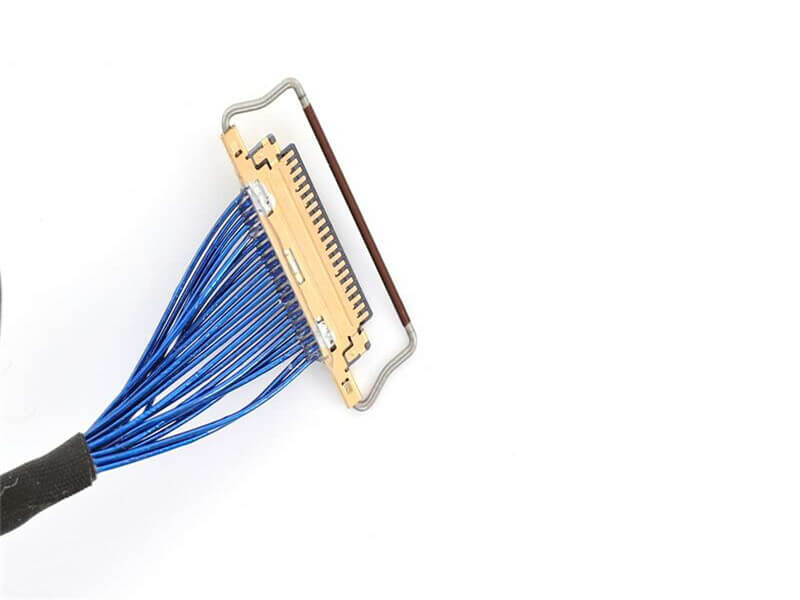
Connector:The I-PEX 20380 utilizes a fine-pitch micro-coax connector designed for high-density, high-speed differential signals, commonly used in laptops and mobile devices.
🚁 Drone-Specific Challenges for Internal Cables
Drone gimbal cables face unique challenges that demand more than generic micro coax:
High Vibration & Torsion:Cables must endure constant multi-directional stress without work-hardening or breaking internal conductors.
Wide Temperature Range:They must perform reliably from -20°C to +85°C or higher, resisting thermal expansion and contraction.
EMI/EMC Sensitivity:With powerful motors and ESCs nearby, cables need superior shielding to prevent video noise, artifacts, or complete signal loss.
Miniaturization vs. Performance:Designers must pack more functionality into smaller spaces, requiring high-density connectors and fine coax cables that don’t compromise signal quality.
Bend Radius & Flex Life:Cables must survive thousands of flex cycles in a gimbal without degradation, a key reason flexible micro-coax is favored over FPC in moving joints.
🔗 I-PEX 20380: A Purpose-Built Solution
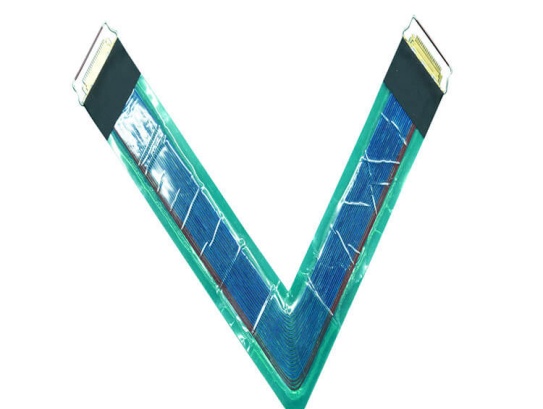
The New I-PEX 20380 micro coaxial cable assemblyis designed to address these challenges head-on. It’s a high-density, fine-pitch coaxial cable assembly that replaces bulky LVDS/MIPI ribbon cables in gimbal camera modules.
Key Features:
Connector:I-PEX MHF® 20380 series, featuring a 0.4mm pitch and a low-profile, robust housing for tight spaces.
Cable Construction:Ultra-fine coax (e.g., 40–46 AWG) with a controlled impedance, ensuring clean signal transmission for multi-gigabit video links.
Shielding:Full-coverage shielding with a drain wire to minimize EMI and maintain signal integrity in noisy environments.
Durability:High-flex, stranded conductors and a flexible jacket provide an excellent flex life, ideal for gimbal mechanisms.
Customization:Available in various lengths (e.g., 100mm, 150mm, 200mm) and pin counts to suit different gimbal and camera designs.
📊 I-PEX 20380 vs. Common Alternatives
Feature
I-PEX 20380 Micro Coax Assembly
Standard FPC/FFC Ribbon Cable
Generic Multi-Coax Harness
Signal Quality
Excellent for high-speed video (MIPI/LVDS) due to controlled impedance and shielding.
Prone to impedance mismatch and crosstalk over long distances.
Good, but performance varies with quality.
EMI Shielding
Superior 360° shielding.
Very limited shielding.
Good, but can be bulky.
Flexibility
Excellent for tight-radius, high-cycle bending (ideal for gimbals).
Industrial/automotive where space is less critical.
🛠️ Integration Tips for Engineers
When integrating the I-PEX 20380, consider the following:
Impedance Matching:Ensure your PCB traces, connectors, and cable are all designed for the same differential impedance (typically 100 Ω) to avoid signal reflections.
Connector Footprint:Follow the I-PEX 20380 datasheet precisely for PCB layout, including keep-out zones and solder mask openings.
Shielding & Grounding:Connect the cable shield to a solid ground plane on the PCB. Use multiple vias near the connector to minimize ground impedance.
Bend Radius:Avoid sharp bends. Follow the manufacturer’s minimum bend radius specification to prevent damage during flexing.
Strain Relief:Use clips, anchors, or glue to relieve mechanical stress from the connector, especially where the cable exits the gimbal housing.
Environmental Protection:For drones exposed to moisture or dust, consider adding strain relief boots or potting at the connector interface.
🎯 Ideal Applications
The I-PEX 20380 micro coaxial cable assembly is an excellent choice for:
Professional Aerial Photography Drones:For gimbals with 4K/8K cameras, zoom lenses, or multi-sensor payloads.
FPV Racing & Freestyle Drones:Where lightweight, high-bandwidth video links are crucial for low-latency FPV feeds.
Industrial Inspection Drones:For gimbals with thermal or zoom cameras that require stable, high-quality video transmission.
Handheld & Robotics Gimbals:Any application needing a small, reliable high-speed video link in a moving joint.
🏭 Partner with FRS for Your Cable Assembly Needs
If you are developing or manufacturing drone gimbals and need a reliable micro coaxial cable for drone cameraconnections, FRS is here to help.
With extensive experience in designing and manufacturing high-performance cable assemblies, FRS specializes in I-PEX micro-coax solutions. We offer:
Custom Design:Tailored cable assemblies based on your specific requirements for length, pitch, shielding, and flexibility.
Rapid Prototyping:Quick turnaround on samples to accelerate your development cycle.
Rigorous Quality Control:In-line and final testing to ensure every cable meets your performance and reliability standards.
Scalable Manufacturing:From small-batch prototypes to high-volume production runs.
Ready to optimize your drone gimbal camera performance?Contact the FRS team today to discuss your project requirements and discover how our I-PEX 20380 micro coaxial cable assemblies can enhance your design.
In the realm of network cabling, twisted pair and coaxial cables stand out as two widely used options. The choice between them can significantly impact the performance, reliability, and cost-effectiveness of your network. To make an inf...
As robotics technology evolves—from industrial mechanical arms on assembly lines to precision medical robots and agile logistics robots—the cables powering and connecting these machines have become far more than simple “wires.R...
In the world of signal transmission, Coaxial Cable Assemblies stand as a critical backbone, powering everything from home entertainment systems to industrial automation and aerospace communications. However, not all Coaxial Cable Assemb...
In the complex web of electrical and data systems that power modern commercial buildings, cable management is a critical yet often overlooked component. Cable trays and ladders serve as the backbone of organized, safe, and efficient cab...
When selecting micro-coaxial cables for high-temperature applications, understanding the temperature tolerance of PTFE-insulated micro-coaxial cables is critical. Polytetrafluoroethylene (PTFE) is a popular insulation material due...
Mechanical Stress ManagementA. Bending and Shaping GuidelinesSemi-rigid cables are designed for one-time bending. Improper shaping can crack the outer conductor, causing signal leakage or impedance mismatches.
Cable Diameter ...
The short answer is yes—coaxial cable assemblies are indispensable components in aerospace systems, serving as the backbone for reliable signal transmission in aircraft, satellites, and spacecraft. Unlike commercial-grade cables, aerosp...
In the era of miniaturization, electronic devices are becoming increasingly compact while demanding higher performance—from wearable fitness trackers and medical implants to aerospace sensors and industrial IoT modules. At the heart of ...
In the high-stakes world of military operations, reliable communication isn’t just convenient – it’s mission-critical and often life-saving. When every gram, millimeter, and split-second counts, micro coaxial cables em...
In today’s hyper-connected world, where 5G networks transmit massive data streams, medical imaging devices capture intricate bodily details, and aerospace systems operate in extreme environments, electromagnetic interference (EMI) poses...
In high-speed, high-density electronic systems, micro coaxial cable assembliesare the critical link that ensures clean, reliable signal transmission. When these assemblies are precision engineered, they become a strategic advantage for ...
When working on high-speed consumer electronics, medical imaging, or 5G devices, you might be told you need a “micro coaxial cable impedance matching service.” This often leads to a simple question: “Isn’t the cable just 50 Ω or 75 Ω? W...
Bundling micro coaxial cables is essential for installations requiring high-density connectivity, such as in medical devices, aerospace systems, robotics, or telecommunications equipment. Incorrect bundling can cause signal interference...
Repeated bending is the silent killer of micro-coaxial cables. If you design wearables, medical devices, robotics, or any product requiring constant movement, achieving 100,000+ flex cycles is critical. Rigorous testing reveals wh...
Micro coaxial cables are the unsung heroes of modern military electronics. Packing powerful signal capabilities into an ultra-thin profile, they’re essential for everything from missile guidance systems and radar to ruggedized com...
Micro coaxial cables (micro coax) are the hidden heroes of our digital lives. Found inside smartphones, laptops, cameras, drones, and countless other devices, these tiny cables carry crucial video signals (like HDMI or camera feeds) and...
In the world of signal transmission, the Signal-to-Noise Ratio (SNR) of coaxial cable assemblies is a critical metric that directly determines the clarity, reliability, and performance of data or radio frequency (RF) signals. Simply put...
Coaxial cable assemblies are critical components in telecommunications, aerospace, industrial automation, and consumer electronics, transmitting high-frequency signals with minimal interference. However, corrosion—caused by moisture, ch...
In the ever-evolving landscape of mobile technology, the development of 6G is on the horizon. With the promise of significantly faster speeds, ultra-low latency, and enhanced connectivity, 6G aims to revolutionize the way we interact wi...
Coaxial cables are vital for transmitting high-frequency signals in various applications, from home TV setups to professional communication systems. Proper maintenance and care can significantly extend their lifespan, ensure consistent ...
High-Frequency Performance (Up to 110+ GHz)Micro coaxial cables are designed to transmit signals at frequencies far exceeding traditional coaxial cables, making them vital for cutting-edge wireless and millimeter-wave technologies.
...
In the realm of industrial and commercial applications, cable repair and protection are critical for ensuring system reliability, safety, and longevity. Among the various solutions available, heat shrink tubing stand...
Last week, a highly anticipated online Q&A session on coaxial cables was successfully held, attracting hundreds of industry professionals, DIY enthusiasts, and individuals seeking to upgrade their home networks. The session featured...
In today’s interconnected world, where cables power everything from data centers to industrial facilities, organized cable identification is more than just a matter of neatness—it’s a cornerstone of efficient operations, safety, and cos...
Radar Systems: Precision Signal TransmissionA. Phased Array AntennasSemi-rigid cables are widely used in military and aerospace radar arrays due to their ability to maintain consistent phase relationships across thousands of elemen...
In industries ranging from telecommunications to industrial automation, coaxial cables serve as the backbone of reliable signal transmission. Yet, one critical performance metric often determines their longevity and functionality in rea...
In the dynamic world of stadiums and arenas, where thousands gather to cheer for their favorite teams or enjoy live performances, a seamless audio-visual (AV) experience is non-negotiable. From giant video screens displaying instant rep...
In today’s interconnected world, the demand for reliable and high-performance communication infrastructure is paramount. Coaxial cables, as a critical component in transmitting audio, video, and data signals, must adhere to strict...
In the world of theater, sound is not just an accessory—it’s a storytelling tool that breathes life into performances. A single note from a violin, a whispered line from an actor, or the roar of a crowd in a musical number must reach ev...
Struggling with signal loss, distortion, or bandwidth limitations in your high-frequency applications? You’re not alone. As our world demands faster data transfer, higher resolution video, and more sophisticated wireless communica...
Yes, micro coaxial cables for endoscope medical equipment can be fully customized to meet the specific needs of different devices and applications.
Customization Options for Micro Coaxial Cable
Micro coaxial cables for endoscopes ...
In the realm of military operations, seamless and secure communication is not just a convenience but a critical determinant of mission success and the safety of personnel. Amidst the array of technologies that enable this, coaxial cable...
In the realm of aviation, where safety, reliability, and precision are of utmost importance, every component within the communication system plays a critical role. Among these components, coaxial cables stand out as essential conductors...
As a silver plated micro coaxial cable manufacturer, we are introducing our new 0.4 mm OD micro coaxial cable series, engineered to meet the demanding requirements of high-density medical devices. This new series addresses the industry&...
Telecommunications and 5G NetworksMicro coaxial cables play a pivotal role in high-frequency communication systems:
5G mmWave Infrastructure:Used in base stations, small cells, and antennas for transmitting 24–100 GHz mmWave sig...
In the era of smart manufacturing, industrial automation systems demand components that balance miniaturization, high performance, and durability. Micro-coaxial cables (often abbreviated as micro-coax) have emerged as a critical solutio...
Medical robots are transforming healthcare, enabling minimally invasive surgeries with superhuman precision, enhancing diagnostics, and improving patient outcomes. At the heart of these sophisticated machines lies an often-overlooked bu...
Understand Your ApplicationThe first step in choosing a coaxial cable is identifying its primary purpose:
TV/Antenna Signals: RG6 cables are ideal for satellite TV, cable TV, and digital antennas due to their high shielding an...
In the fast-paced world of live event production, from concerts and sports matches to conferences and theater shows, reliable signal transmission is the backbone of a successful event. Among the various cables used, coaxial cable stands...
In the world of broadcasting, nothing frustrates listeners or viewers more than a distorted signal. Interference can ruin the entire experience, whether it’s static on a radio, pixelation on a TV, or dropped audio in a live stream. Achi...
IntroductionThe High-Temperature Resistant Micro-Coaxial Cable is a cutting-edge connectivity solution engineered to deliver exceptional performance in extreme thermal environments. Combining precision engineering with advanced mate.
Overview of I-PEX Micro Coaxial Cable Connectors
I-PEX is a global leader in micro coaxial cable solutions, specializing in high-performance IPEX micro coax connectors and micro coaxial cable assemblies. These products are designed for.
Contact Us Micro Coaxial Cable factory-(FRS).
Feel free to reach out to us for any inquiries or orders