Product overview and where it’s used
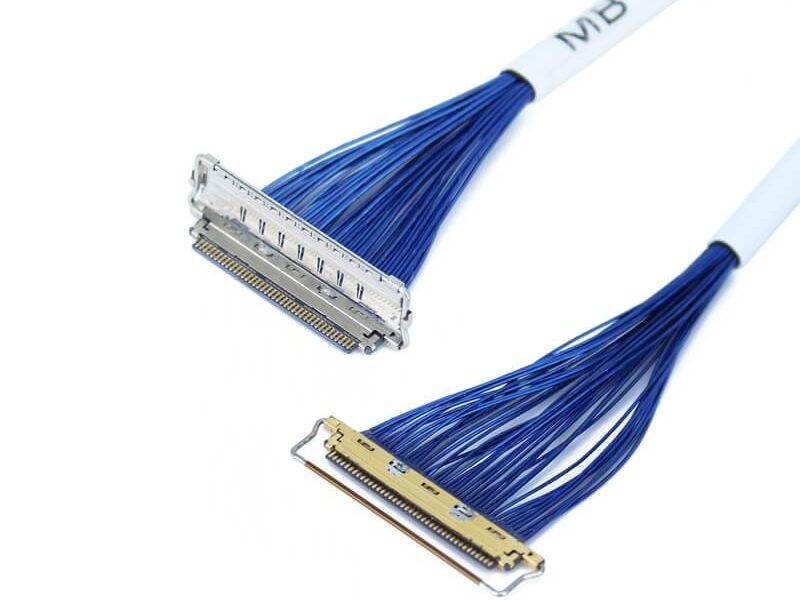
- The Hirose DF36is a 0.4 mm pitch, vertical-matingmicro-coaxial cable connector family built for ultra-compact, high-density interconnections. It is widely adopted in smartphones and mobile devices(display, camera, battery, fingerprint), wearables(watch, AR/VR, earbuds), drones and gimbals(flight controller, GPS, vision), security and IP cameras, and industrial/medical handhelds. Typical benefits include excellent EMI shielding in a 1.5 mm mated heightform factor and a secure four-point click lock. The series is available in multiple pin counts and supports fine coax cables, making it a go-to when routing space is extremely limited but signal integrity matters.
Key specifications and what they mean
- Mechanical and mating
- Pitch: 0.4 mm; mated height: 1.5 mm(both standard and space-saving types). Depth: 4.4 mm(standard), 2.8 mm(space-saving). Effective mating length: 0.4 mm. Four-point lock (2 points per end) with clear tactile click.
- Electrical
- Rated voltage: 30 V AC. Rated current: AWG42/44: 0.25 A, AWG46: 0.1 A. Contact resistance: ≤80 mΩ(signal/ground). Insulation resistance: ≥50 MΩ(100 V DC). Withstand voltage: 100 V AC/1 min.
- Environmental and durability
- Operating temperature: -35 to +85°C. Operating humidity: 20–80%RH. Vibration: 10–55 Hz/0.75 mm, 10 cycles per axis. Temperature cycle: -55→+85°C, 5 cycles. Mating durability: 30 cycles.
- Materials and shielding
- Insulator: LCP (UL94V-0). Contacts: phosphor bronze, gold plating. Exterior shell: phosphor bronze, tin plating(space-saving type: gold). RoHS2, halogen-free. The standard type adds multi-point ground springsfor stable EMC performance; the plug shell connects to the receptacle shell for continuous shielding.
- Wiring and variants
- Accepts AWG42/44/46micro-coax. Common pin counts: 15, 20, 25, 30, 40, 45, 50(availability varies by variant). Typical maximum jacket diameter for a 40-positionDF36 variant is around φ0.33 mm(check your exact part number).
How to select the right DF36 variant and cable
- Board space vs EMC: choose the standard typeif EMC is critical (it includes multi-point ground springs); choose the space-saving typewhen PCB depth is extremely constrained (no ground springs, but still excellent shielding via shell-to-shell contact).
- Pin count and layout: match the number of signal linesin your interface (e.g., differential pairs, clock, control). Ensure your PCB footprint and keep-out match the chosen variant’s depth and keep clearances for the 0.4 mm pitchlayout.
- Current per pin: size your design so each signal line’s current is ≤0.25 A (AWG42/44)or ≤0.1 A (AWG46). If higher currents are needed, use more pins in parallel or move power to wider copper planes.
- Cable selection: use AWG42/44/46micro-coax with compatible outer diameter for strain relief and bend radius. Keep the overall cable OD within the connector’s specified limits (e.g., ≤φ0.33 mmjacket OD for many 40-pos variants).
- Mechanical routing: respect minimum bend radius and avoid sharp folds near the connector. Maintain strain relief at the strain relief point to prevent force on the mated interface.
- EMI practices: ensure the shell-to-shellcontact is clean and continuous to chassis ground at both ends; route shields consistently and avoid pig-tailing grounds. Use grounded pads under the receptacle if needed.
Assembly, soldering, and handling best practices
- Preparation: keep connectors clean and dry; avoid touching gold-plated contacts. Use ESD precautions. Verify cable preparation (center conductor length, shield flare) before insertion.
- Cable termination: follow the official Hirose-recommended reflow profilefor SMT receptacles. For hand soldering, limit to 350°C for ≤3 sand avoid prolonged dwell to prevent damage. The DF36 features a nickel barrierto help prevent solder wicking into critical contact areas.
- Shield continuity: ensure the plug shellmakes full metal-to-metal contact with the receptacle shell; on the standard type, confirm the multi-point ground springsare not deformed. Maintain 360° shield continuity through the cable braid to the connector shell.
- Locking and inspection: engage the four-point lockuntil you feel the click; inspect for full seating, shell alignment, and any shield deformation. Perform continuity/insulation and, where applicable, hipot testing on a sample basis.
- Environmental care: operate and store within the rated temperature/humidityranges. Avoid condensation and contamination in the mated interface; use dust caps when unmated.
Troubleshooting and reliability tips
- No continuity or high resistance: re-seat the connector to ensure full shell contact; inspect for bent pins or shield misalignment. Check solder joints for cold joints or wicking.
- Intermittent connection: verify strain relief is effective and that cables are not pulling on the mated pair. Check for cracked insulator or deformed shell.
- EMI issues: confirm shield continuity end-to-end, ensure chassis ground connections are solid, and inspect for ground spring deformation (standard type). Route differential pairs symmetrically and maintain consistent reference planes.
- Mechanical shock or drop: the four-point lockand robust plug shell improve retention, but verify after any drop event that all pins are mated and the lock is fully engaged.
- Environmental failures: if operating near the temperature/humiditylimits, ensure conformal coating or potting is compatible with the connector’s materials and does not compromise the mating interface.
Designing for high-speed signals and EMI control
- The DF36’s coaxial, grid-likeconstruction with individual shields per conductor is well-suited for dense, high-speed links such as MIPI CSI-2/D-PHYor LVDSin space-constrained systems. For best results:
- Match differential pair impedance to your system (often ~100 Ω differential, but follow your controller/PHY requirements).
- Keep differential pairs tightly coupled and of equal length; avoid stubs and unnecessary vias near the connector.
- Maintain a continuous ground reference and minimize return path discontinuities. Use ground stitching near the connector footprint.
- Control cable routing to reduce crosstalk and maintain symmetry; avoid routing high-speed pairs adjacent to noisy switching lines.
- Validate with channel simulation and compliance testing (e.g., eye diagram, insertion loss, return loss, EMI) using your specific cable length and stackup.
- The DF36 family is commonly used in security/IP camerasand other imaging systems where space and EMI are both critical; review your system’s speed grade and environmental class to select the right variant and perform system-level validation.
Mechanical drawings, part numbers, and ordering guidance
- Understanding the part number structure is essential for ordering the correct DF36 micro coaxial cable assembly. Typical elements include series (DF36), variant (Afor space-saving, none for standard), number of positions (e.g., 30), contact type (Pfor plug, Sfor receptacle), termination (0.4SDfor SMT plug, 0.4Vfor SMT receptacle), and packaging code (e.g., (51)for embossed tape). Examples:
- Plug: DF36-30P-0.4SD(51)(plug, 30 circuits, SMT, tape packaging).
- Receptacle: DF36A-30S-0.4V(51)(space-saving receptacle, 30 circuits, SMT, tape).
- Cable assembly: your supplier will combine the appropriate plug/receptacle with specified AWGmicro-coax, length, and labeling per your drawing. Always verify the depth(2.8 mm vs 4.4 mm), mated height (1.5 mm), and pin countagainst your PCB footprint and mechanical constraints. For detailed dimensions, keep the official DF36 product page and catalog handy during layout and BOM creation.