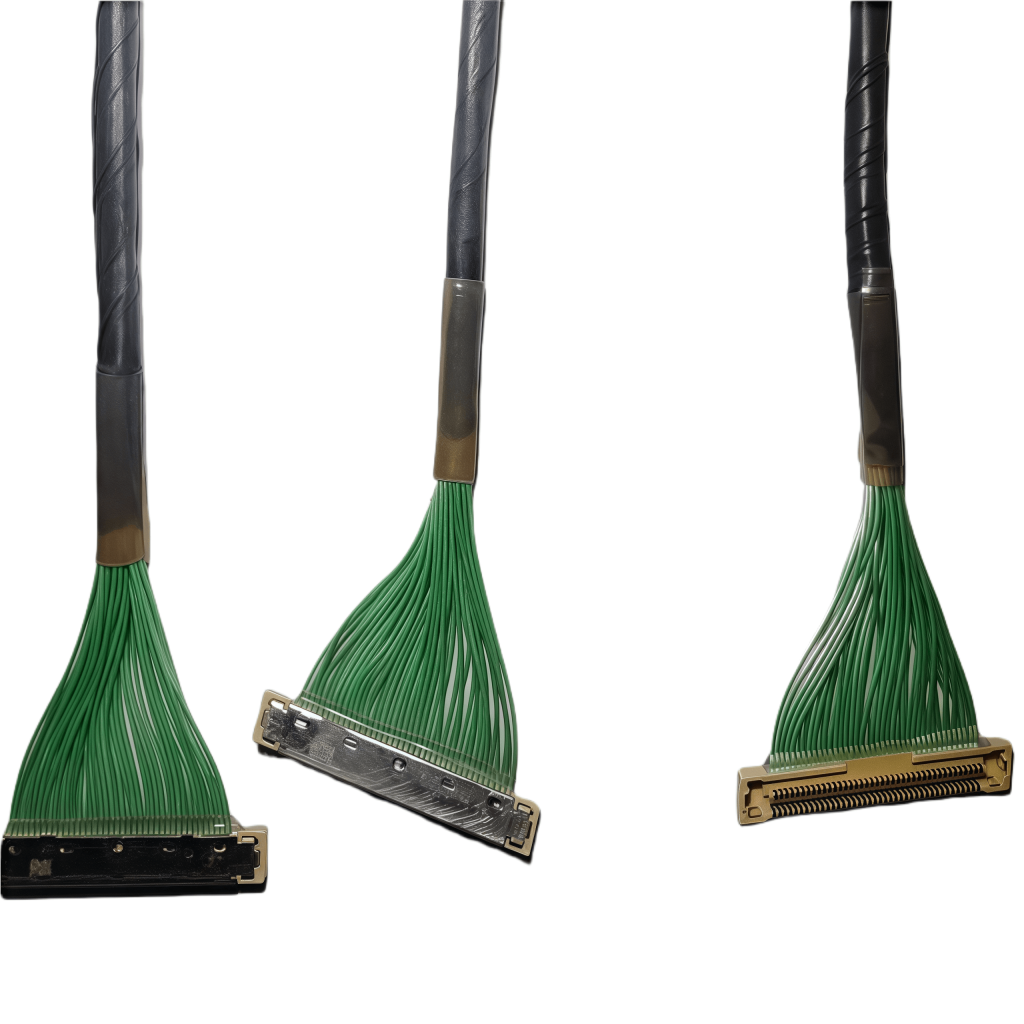
5G technology promises incredible speed, massive capacity, and ultra-low latency. To deliver on this promise, especially for mid-band and crucially for high-band (millimeter wave or mmWave) frequencies, network operators are deploying vast numbers of small cells – compact radio units placed densely in urban areas, inside buildings, on streetlights, and more. While these small cells are the workhorses of dense 5G networks, connecting them efficiently poses unique challenges that demand specialized cable solutions, specifically high-performance micro-coaxial cables. Here’s why:
Extremely High Frequencies & Bandwidth:
5G, particularly mmWave (24GHz and above), operates at frequencies where traditional cabling struggles immensely.
Standard RF cables experience significant signal loss (attenuation) as frequency increases. At mmWave frequencies, this loss over even short distances can severely degrade signal quality and drastically reduce the effective range of the small cell.
Micro-coaxial solutions are engineered with optimized materials and precise construction to minimize this attenuation at high frequencies, ensuring maximum signal power reaches the antenna and usable signal is received back.
Minimizing Size and Weight:
Small cells are designed to be discreet and deployable almost anywhere – lamp posts, building facades, ceiling tiles, bus stops. Space is incredibly tight, both externally and internally within the small cell enclosure.
Traditional coaxial cables can be bulky and heavy, making installation difficult and visually obtrusive.
Micro-coaxial cables feature dramatically smaller diameters and lighter weights compared to standard coax, making them ideal for the constrained spaces found in and around small cells. Their flexibility simplifies routing through tight spots inside the unit or along cramped pathways during deployment.
Uncompromising Signal Integrity in Noisy Environments:
Small cells are deployed in electromagnetically noisy environments – crowded street furniture, dense electronics within buildings, other wireless signals. Maintaining clean signal transmission is critical.
Shielding Effectiveness is paramount. Micro-coaxial cables employ sophisticated, often multi-layered, shielding designs (like multi-layer tape & braid) to block out interference and prevent the small cell’s own RF signals from leaking out and causing issues (EMI/RFI).
Stable Phase & Amplitude: For advanced 5G techniques like beamforming and Massive MIMO (Multiple Input Multiple Output), which rely on precise signal timing across multiple antenna elements, the phase characteristics of the cables feeding those antennas must be extremely stable and consistent. Specialized micro-coax offers this critical phase stability.
Durability & Reliability in Harsh Conditions:
Small cells live outdoors exposed to weather (rain, snow, UV), extreme temperatures, vibrations, and mechanical stresses. Indoor units may face humidity and dust.
General-purpose cables can degrade quickly in these conditions, leading to failures and increased maintenance costs.
Robust Micro-Coaxial cables are built with durable outer jackets resistant to environmental factors, corrosion-resistant connectors, and stable dielectric materials that maintain performance over temperature swings and time, ensuring long-term network reliability.
Supporting High Power Levels:
While small cells cover smaller areas than macro towers, they still need to transmit sufficient power. Some operate under Active Antenna Systems (AAS) architectures requiring significant power over the RF cable.
Micro-coaxial solutions designed for small cells incorporate conductors capable of handling the necessary current without excessive loss or heat generation.
Ease and Speed of Deployment:
Deploying thousands or millions of small cells requires efficient installation. Cables that are easy to handle, route, and connect significantly reduce installation time and cost.
The lightweight, flexible nature of specialized micro-coax, often paired with compact, reliable connectors, facilitates faster rollouts and simpler maintenance access.
In Simple Terms:
Think of the data flowing to and from a 5G small cell antenna as water under high pressure. To get it where it needs to go powerfully and cleanly:
You need a strong, leak-proof hose (high shielding effectiveness).
You need a hose wide enough to handle the flow but small enough to fit through narrow spaces (small diameter, optimized for high frequency flow).
You need a hose that doesn’t let the water pressure drop significantly over its length (low signal attenuation).
You need a hose that doesn’t kink or break easily in tough weather (durability).
You need every drop arriving at the exact right time for complex systems to work (phase stability).
Standard hoses (generic RF cables) fail on one or more of these points for 5G small cells. Specialized micro-coaxial solutions are engineered precisely to meet all these demanding requirements simultaneously.
Conclusion:
The leap to 5G, especially harnessing its full potential with high-band mmWave, is fundamentally reliant on dense small cell networks. These small cells operate under severe constraints of size, environment, and performance demands. Attempting to connect them with legacy or generic cabling solutions compromises network performance, reliability, and ultimately, the user experience. Specialized high-frequency micro-coaxial cables are not just an option; they are an absolute engineering necessity for deploying effective, reliable, and future-proof 5G small cell networks that deliver the transformative speed and capacity users expect. Choosing the right micro-coax solution is critical to unlocking 5G’s true potential.
IntroductionMicro-coaxial cables are essential components in modern electronics, telecommunications, and medical devices. Whether you’re designing a high-frequency circuit, a medical imaging system, or a compact consumer gadget, choosin...
Anti-static micro coaxial cables are critical components in high-precision electronics, telecommunications, and medical devices. Their assembly requires a controlled environment to prevent electrostatic discharge (ESD), which can damage...
Coaxial cables are the unsung heroes of modern connectivity, powering everything from home televisions and internet routers to security cameras and satellite systems. Their unique design—featuring a central conductor, insulating layer, ...
Routing micro coaxial cables efficiently and reliably within compact electronic devices, dense PCBs, or tight mechanical enclosures requires careful planning and specific techniques. Improper routing can lead to signal degradation, elec...
Finding reliable signal transmission cables for hot environments like engine compartments, industrial machinery, or aerospace systems can be a major headache. Standard cables degrade, signals falter, and equipment fails prematurely. Tha...
A coaxial cable is a type of cable widely used in communication and data transmission. Its core structure consists of four concentric layers:Central Conductor: Typically a single or stranded copper wire for transmitting electrical sig...
Micro coaxial cables are essential workhorses in modern electronics, carrying high-frequency signals in applications like 5G phones, medical devices, radar systems, and high-speed data links. As signals travel faster, a phenomenon calle...
Getting those critical radio frequency (RF) signals – whether in your satellite communication equipment, medical scanner, drone control link, or tiny IoT sensor – from point A to point B without degradation is non-negotiable...
Choosing the best micro coaxial cable for 4K/8K displays is not about finding a single “magic” part number. It is about matching the cable’s electrical, mechanical, and system-level characteristics to your display interface, resolution,...
The short answer is yes, coaxial cable assemblies can be recycled after use—but the process requires careful handling due to their composite structure. As the world grapples with the growing problem of electronic waste (e-waste), recycl...
Coaxial cable assemblies are critical components in countless electronic systems, from telecommunications and aerospace to medical devices and industrial automation. Their performance directly impacts the reliability, signal integrity, ...
Coaxial cable assemblies are the backbone of high-frequency communication systems, enabling reliable signal transmission in applications ranging from telecommunications and aerospace to medical devices and industrial automation. Their a...
When working with electronics, robotics, or high-frequency communication systems, understanding the properties of cables is crucial. One common question is: What is the typical impedance of a micro coaxial cable? In this article, ...
In today’s connected world, reliable cable and signal performance is crucial—whether for home networks, business setups, or industrial systems. When issues like slow data transfer, weak signals, or total outages occur, cable testers and...
Cable glands, often referred to as cable connectors or cable fittings, are critical components in electrical and mechanical systems, designed to create a secure, environmental seal where cables enter enclosures, equipment, or junction b...
In industrial, commercial, and even residential settings, protecting electrical cables from physical damage, environmental hazards, and external interference is crucial for ensuring reliable performance and safety. Conduits and raceways...
The short answer is yes—coaxial cable assemblies can transmit both power and data, but this capability depends on deliberate design, component selection, and alignment with specific application requirements. Unlike single-function cable...
Industrial grade micro coaxial cable is an ultra‑thin, high‑performance RF interconnect built for demanding applications that require precise impedance control, high‑density routing, and long‑term reliability under mechanical and enviro...
Venturing beyond Earth’s protective magnetic shield means facing a relentless, invisible enemy: space radiation. For the intricate electronic systems powering satellites, rovers, and deep-space probes, this radiation isn’t j...
supported by technical benchmarks and industry standards.
Structural Design and MaterialsA. Semi-Rigid Coaxial CablesOuter Conductor: Made from solid copper, aluminum, or stainless steel tubing, cold-formed into a permanent sh...
What Defines a Coaxial Cable?A coaxial cable (“coax”) has a concentric layered design that ensures signal integrity:
Central Conductor: A solid or stranded copper core for signal transmission.Dielectric Insulator: Surrounds th...
The short answer is yes—coaxial cable assemblies can be reliably used in underwater projects, but their performance depends entirely on targeted design, material selection, and compliance with underwater environmental constraints. Unlik...
IntroductionAs autonomous vehicles (AVs) evolve, LiDAR (Light Detection and Ranging) systems have emerged as a cornerstone technology for enabling safe navigation. These systems rely on precise data transmission to map environments in r...
Recently, our factory’s high-performance coaxial cable has officially clinched the Green Product Award, a distinguished honor presented by the International Green Technology & Sustainability Council (IGTSC) following a strict t...
1. The Unique Advantages of Coaxial Cable in Office Network Infrastructure
1.1 High Bandwidth for Demanding Data Transmission
Coaxial cables excel in providing superior bandwidth compared to traditional twisted pair cables, making...
In the ever-evolving landscape of modern communication, coaxial cable stands as an indispensable pillar, facilitating the seamless transmission of signals across a vast array of applications. From television broadcasting to high-speed i...
In the dynamic world of modern manufacturing, multi-robot assembly lines represent the pinnacle of efficiency, speed, and precision. These complex systems, where multiple robotic arms collaborate seamlessly, demand flawless communicatio...
In the realm of wireless communication, wireless base stations serve as the vital hubs connecting devices to networks. And among the key components ensuring their smooth operation, coaxial cables play an indispensable role. This article...
Overview and definition
A micro coaxial cable with an I-PEX 20373 connector is a miniaturized, shielded interconnect built to carry high‑speed differential or single‑ended signals between tightly spaced PCBs or modules. The I‑PEX 203...
In an era where data breaches and signal interception pose existential threats to businesses and critical infrastructure, the choice of transmission medium is no longer a matter of convenience—it is a cornerstone of network security. Wh...
In satellite communications—where signals travel across thousands of kilometers of space and face extreme environmental stress—micro-coaxial cables (micro-coax) serve as critical “neural links.” Unlike standard coaxial cable...
In the rapidly evolving landscape of electronic devices and communication systems, the demand for high-performance signal transmission solutions has never been more critical. Among the various components that enable seamless data and si...
Fundamentals of Bend Radius in Micro-Coaxial CablesA. Definition of Bend RadiusThe minimum bend radius (MBR) is the smallest allowable curvature a cable can withstand without permanent deformation or electrical performance degrad...
In the realm of industrial and commercial applications, cable repair and protection are critical for ensuring system reliability, safety, and longevity. Among the various solutions available, heat shrink tubing stand...
What Are Medical Ultra-Fine Coaxial Cables?Ultra-fine coaxial cables are specialized cables designed for high-frequency signal transmission in compact environments. Unlike standard coaxial cables, they feature:
Microscopic Diameter...
In the intricate world of scientific research equipment, coaxial cables play a pivotal role. These cables are not just ordinary connectors; they are the lifelines that ensure seamless data transfer, precise signal transmission, and reli...
In the modern healthcare system, a stable and efficient network is not just a support system but a critical component that directly impacts patient care, medical workflow, and data security. Hospitals handle massive volumes of sensitive...
You use Starlink for video calls, streaming, or staying connected off-grid. But have you ever wondered how thousands of satellites overhead work flawlessly in the brutal environment of space? One unsung hero is surprisingly sm...
Imagine a future where downloading full HD movies takes seconds, complex brain scans happen in real-time, and next-gen technologies like AI and the metaverse flow without a stutter. The key? Unleashing unprecedented speed and bandwidth ...
As the shimmering horizon of 6G technology comes into focus, promising mind-boggling speeds (Terabit-level!), near-instant communication (ultra-low latency), and revolutionary applications like holographic telepresence and pervasi...
OverviewMicro-Coax for HD Video is a cutting-edge coaxial cable engineered to deliver uncompromised high-definition video quality across professional and industrial applications. Designed for reliability, precision, and versatility,.
Meta Description: Discover the advanced features and benefits of Industrial Micro-Coaxial Wiring—engineered for precision, durability, and high-speed signal transmission in industrial environments.
What is Industrial Micro-Co.
Contact Us Micro Coaxial Cable factory-(FRS).
Feel free to reach out to us for any inquiries or orders