Venturing beyond Earth’s protective magnetic shield means facing a relentless, invisible enemy: space radiation. For the intricate electronic systems powering satellites, rovers, and deep-space probes, this radiation isn’t just a background nuisance – it’s a mission-critical threat. One often-overlooked yet vital component facing this onslaught is the humble micro-coaxial cable. Standard cables simply won’t survive. Radiation-resistant micro-coaxial cables are not a luxury; they are an absolute necessity for reliable space exploration.
Why Space Radiation is a Cable Killer
Space is flooded with high-energy particles from the sun (solar particle events) and distant galaxies (galactic cosmic rays). When these particles strike materials within spacecraft:
Ionization: Particles knock electrons loose, creating charged regions that can disrupt delicate electrical signals traveling through cables, causing noise, signal distortion, or complete loss.
Displacement Damage: High-energy particles can physically knock atoms out of place in the cable’s insulating materials (dielectrics) and conductors. This permanently degrades the material’s electrical properties over time, increasing signal loss (attenuation) and altering impedance.
Total Ionizing Dose (TID): The cumulative effect of radiation exposure gradually degrades insulating materials, making them brittle and conductive, leading to short circuits or leakage.
Single Event Effects (SEEs): A single high-energy particle strike can cause sudden, catastrophic failures like latch-up (a short circuit condition) or burnout in sensitive components connected by the cables.
Ordinary micro-coaxial cables, designed for benign Earth environments, rapidly succumb to these effects. Signal integrity plummets, data is corrupted, power delivery falters, and critical systems can fail prematurely, potentially dooming multi-billion dollar missions.
How Radiation-Resistant Micro-Coaxial Cables Fight Back
Engineers combat space radiation through specialized design and materials:
Radiation-Hardened Dielectrics: Replacing standard plastics (like PTFE) with specially formulated polymers or inorganic materials (e.g., radiation-resistant PTFE blends, polyimides, or mineral-filled composites) that maintain their insulating properties and structural integrity under intense radiation exposure, minimizing TID effects and signal loss.
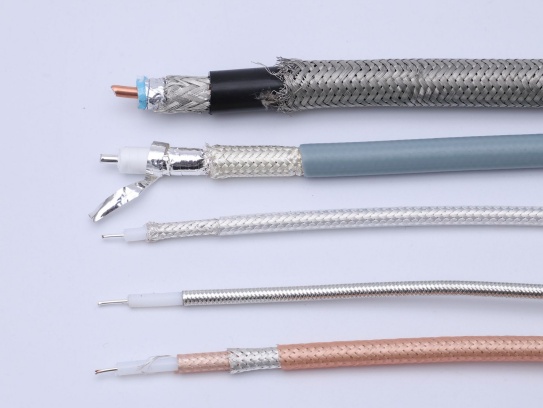
Enhanced Shielding: Utilizing high-purity, radiation-tolerant metals (like silver-plated copper) for the braid or foil shield. Optimized shield coverage (often >95%) is crucial to block electromagnetic interference (EMI), which can be exacerbated by radiation-induced noise, and provide some particle shielding.
Robust Jacket Materials: Selecting outer jackets that resist radiation-induced embrittlement, cracking, and outgassing (releasing trapped gases that can contaminate sensitive optics or instruments).
Precision Engineering: Maintaining extremely tight tolerances on conductor geometry and dielectric consistency ensures stable impedance and minimizes signal reflections, which is critical for high-frequency data transmission common in space applications, even as materials experience slight radiation-induced changes.
Rigorous Testing: Cables destined for space undergo exhaustive testing per standards like ESA ESCC 3901 or NASA-specific protocols. This includes exposure to controlled gamma-ray or proton sources to simulate years of mission radiation dose, followed by thorough electrical and mechanical performance verification.
Why Micro-Coaxial? The Space Advantage
Micro-coaxial cables (typically with outer diameters below 2mm) are uniquely suited for space:
Miniaturization: Spacecraft and instruments are incredibly weight and volume-constrained. Micro-coax delivers high-frequency signal integrity in a tiny package.
High-Frequency Performance: Essential for transmitting high-speed data (sensor readings, images, communications) and precise RF signals (radar, scientific instruments) over distances within a spacecraft.
Flexibility: Allows for routing through tight spaces and around complex instrument assemblies.
Shielding Effectiveness: Provides excellent protection against both external EMI and internally generated noise, crucial in densely packed electronic systems.
Choosing the Right Cable: What Engineers Need to Know
Voltage Standing Wave Ratio (VSWR) isn’t just a technical specification – it’s the heartbeat of signal integrity in critical applications. Nowhere is this truer than in the demanding worlds of medical devices and advanced au...
Micro-coaxial cables are essential for transmitting high-frequency signals in devices like routers, TVs, and medical equipment. When these cables get damaged, choosing the right repair method—soldering or compression connectors—ca...
Coaxial Cable Assemblies are the backbone of reliable signal transmission in industries ranging from telecommunications and aerospace to medical equipment and industrial automation. Unlike generic cables, these assemblies—comprising a c...
When shopping for coaxial cables, one of the most common questions is: “How much does one meter of coaxial cable cost?” While prices vary based on factors like quality, type, and brand, this guide breaks down everything you ...
In the relentless push for smaller, faster, and more powerful electronics – from cutting-edge medical devices and aerospace systems to next-gen telecommunications and high-resolution imaging – high-density micro-coaxial cable bundles&n...
The relentless pursuit of innovation in medical technology demands components that deliver exceptional performance within increasingly constrained spaces. Micro coaxial cables have emerged as a critical enabling technology, directly con...
In the highly competitive coaxial cable market, after – sales service has gradually become a key factor for enterprises to gain an advantage. However, the traditional after – sales service system has exposed many shortcoming...
Introduction: Precision in Motion Demands Resilience
In the intricate dance of modern electronics, where devices vibrate on factory floors, rumble down highways, endure turbulent flights, or operate within intricate medical instrumen...
In industries ranging from automotive electronics to aerospace and smart home installations, the demand for coaxial cables that perform reliably in narrow spaces has grown exponentially. Traditional coaxial cables, however, often strugg...
Coaxial cable assemblies are critical for signal transmission in industries like telecommunications, aerospace, medical equipment, and industrial automation. Over time, wear, environmental damage, or poor maintenance can degrade their p...
In high-speed, high-density electronic systems, the micro coaxial cableis the workhorse that carries critical RF, high-speed digital, and video signals. However, the mere presence of a high-quality cable is not enough. The point where t...
The choice between flexible and semi-rigid micro-coaxial cables hinges on balancing mechanical robustness, electrical performance, and application-specific requirements.
IntroductionMicro-coaxial cables are critical for high-frequen...
For engineers and system designers working with micro coaxial cables in applications demanding movement and reliability – medical robotics, wearable tech, aerospace assemblies, sophisticated test equipment – conductor stranding is...
Micro coaxial cables are the essential workhorses carrying signals in our compact electronics – from the latest smartphones and medical devices to intricate aerospace systems. But what makes one micro coax better than another? Often, th...
When engineers specify micro coaxial cable assemblies, one of the first and most critical questions is: “What impedance values can you actually achieve?”The answer determines signal integrity, return loss, and overall system performance...
You’re investing in noise-canceling (ANC) headphones for one primary goal: pristine audio in a noisy world. While features like driver size and ANC chip tech get much attention, a crucial component hidden inside plays a massive ro...
The question of whether coaxial cable assemblies are resistant to water and moisture does not have a simple “yes” or “no” answer. Their resistance largely depends on design, materials, and manufacturing processes...
The answer is a resounding yes. Coaxial cable assemblies are indispensable components in broadcast television systems, playing a critical role in ensuring the reliable, high-quality transmission of audio and video signals throughout the...
The Game-Changing Technology
Flexible micro-coaxial cables are revolutionizing electronics by allowing devices to bend and fold without breaking internal connections. These hair-thin cables (often thinner than 0.2mm) maintain strong ...
In the rapidly evolving landscape of medical diagnostics, precision, reliability, and miniaturization have become the cornerstones of technological advancement. Among the countless components that power cutting-edge diagnostic equipment...
Selecting the right dielectric material for micro coaxial cables is critical for high-frequency performance, reliability, and cost-effectiveness. Polytetrafluoroethylene (PTFE) and Polyethylene (PE) are the two dominant contenders. Unde...
As smart agriculture transforms traditional farming into data-driven precision operations, the demand for robust, high-performance connectivity solutions has never been greater. Micro-coaxial cables (micro-coax), with their compact desi...
The short answer is: Yes, coaxial cable assemblies are not only compatible with 5G network devices but also play a critical role in 5G signal transmission—provided they meet 5G’s unique technical requirements. Unlike 4G, 5G relies on hi...
Introduction
In today’s high-speed digital world, micro-coaxial cables have become the unsung heroes of signal transmission. While most discussions focus on cable types or connectors, the critical role of precisely customized c...
Choosing the right micro-coaxial cable isn’t just a detail in drone design and operation; it’s a critical factor impacting video transmission reliability, control signal integrity, weight, and ultimately, the success of your...
In the world of broadcasting, nothing frustrates listeners or viewers more than a distorted signal. Interference can ruin the entire experience, whether it’s static on a radio, pixelation on a TV, or dropped audio in a live stream. Achi...
In the complex and demanding landscapes of industrial environments, high – temperature coaxial cables have emerged as an indispensable component. These cables are engineered to withstand extreme heat, ensuring reliable signal tran...
In the realm of public safety communications, reliability and performance are non-negotiable. Coaxial cables have long been a cornerstone in ensuring seamless and secure transmission of data, voice, and video, playing a crucial role in ...
In today’s hyper-connected world, coaxial cables remain the backbone of reliable signal transmission across industries—from telecommunications and broadcasting to data centers and home entertainment. As technology evolves, so do the dem...
5G carrier aggregation (CA) has emerged as a cornerstone technology to unlock the full potential of next-generation wireless networks, enabling higher bandwidth, lower latency, and seamless connectivity across diverse use cases—from urb...
In the demanding arenas of defense, aerospace, and industrial applications, reliability isn’t optional – it’s mission-critical. Equipment deployed on battlefields, aboard aircraft, within satellites, or on rugged factory fl...
In modern technology, micro coaxial cables are vital for seamless data transmission and signal integrity. With their concentric design, they handle high-frequency signals with low loss and interference. As tech advances, their demand su...
In the fast-evolving global communications and electronics industry, high-performance coaxial cables are the unsung backbone of stable signal transmission—from 5G base stations to data centers and professional broadcast systems. Recentl...
In the operating rooms of today, surgical robots have redefined the boundaries of precision and minimally invasive care—navigating tortuous vascular pathways, performing millimeter-scale tissue resections, and transmitting real-time 4K ...
In modern electronics, micro coaxial cables are vital for high – frequency signal transmission. However, temperature is a significant environmental factor influencing their performance.
Understanding Micro Coaxial Cables
Mic...
Satellite communication ground stations are critical hubs for global connectivity, enabling everything from weather forecasting to internet access in remote areas. At the heart of these systems lies a component often overlooked but esse...
In our interconnected world, micro coaxial cables are vital in various applications. Ensuring their signal quality is crucial for system functionality. This article offers key insights and practical guidance on testing.
Why is Testin...
In the highly competitive coaxial cable industry, our factory’s products have recently garnered widespread acclaim from industry experts, and their positive evaluations have become a hot topic in the market.
A team of well-know...
Micro coaxial cables, the unsung heroes of compact, high-frequency electronics, are critical for transmitting signals with minimal degradation. Among their key performance parameters, insertion loss is paramount. Understanding the...
In LVDS (Low Voltage Differential Signaling) display systems, Micro-coaxial Cable (also referred to as Micro Coax Cable) stands out as an optimal solution for high-resolution, high-reliability signal transmission. Designed to meet the str.
Meta Description: Discover premium RF micro coaxial cables engineered for high-frequency signal transmission in compact devices. Explore specs, applications, and benefits for telecom, medical, and aerospace industries.
.
Contact Us Micro Coaxial Cable factory-(FRS).
Feel free to reach out to us for any inquiries or orders