In the demanding arenas of defense, aerospace, and industrial applications, reliability isn’t optional – it’s mission-critical. Equipment deployed on battlefields, aboard aircraft, within satellites, or on rugged factory floors must perform flawlessly under punishing conditions. When it comes to transmitting vital signals and power, Military-Grade Micro-Coaxial Cables represent the pinnacle of resilience, explicitly designed to withstand extreme environments where standard cables would rapidly fail. This article explores why these specialized cables are the indispensable backbone of high-stakes connectivity.
Confronting the Harshest Conditions: What “Extreme” Demands
Extreme environments subject cables to a brutal combination of stresses:
Extreme Temperatures: Scorching heat inside jet engine bays or electronic enclosures (-65°C to +200°C+ range common). Bitter cold during arctic operations or high-altitude flight. Rapid thermal cycling causes expansion, contraction, and material degradation.
Intense Vibration & Shock: The relentless shaking experienced on armored vehicles, rocket launches, heavy machinery, or during weapon deployment can fracture conductors and insulation.
Aggressive Chemicals & Fluids: Exposure to hydraulic fluids, jet fuels, solvents, de-icing agents, salt spray, and industrial corrosives can dissolve or swell standard cable insulation and jackets.
Abrasion & Crush: Routed through tight spaces, bulkheads, or heavy equipment, cables face constant scraping, pinching, and crushing forces.
High Humidity & Moisture Ingress: Operation in tropical climates, maritime settings, or exposure to washdowns necessitates impervious sealing against moisture, preventing shorts and corrosion.
Intense Electromagnetic Interference (EMI): Proximity to powerful radar, communication systems, motors, and electronic warfare requires superior shielding to prevent signal disruption or leakage.
Standard commercial coaxial cables simply lack the engineered solutions to survive this onslaught.
The Fortress Within: Engineering Secrets of Military-Grade Micro-Coax
Military-grade micro-coax doesn’t just happen; it’s meticulously engineered for survival:
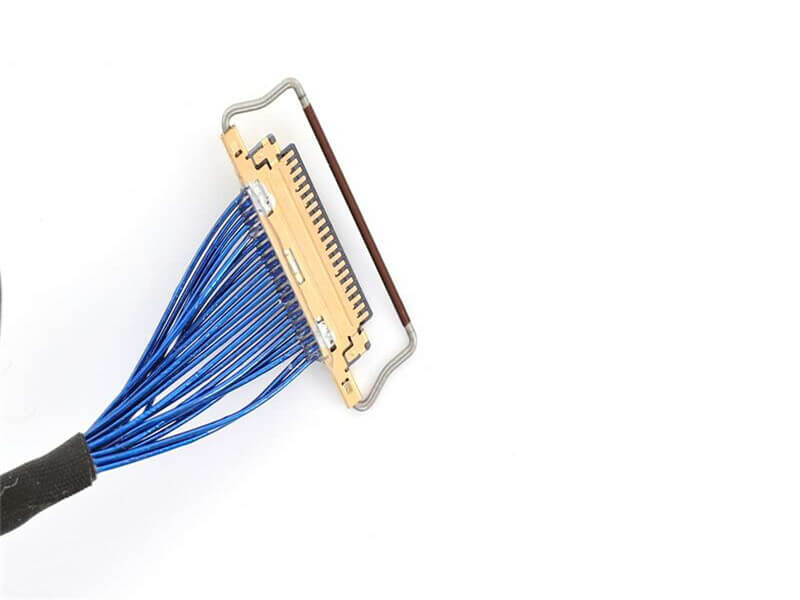
Advanced Dielectrics: Utilizing high-performance fluoropolymers (e.g., PTFE, FEP, PFA) or cross-linked polymers that maintain stable electrical properties across extreme temperature ranges (-65°C to +200°C or beyond) and resist chemical attack.
Robust Shielding: Triple shielding is often standard – combining braided shields (for flexibility and strength) and foil shields (for 100% coverage) – achieving exceptional EMI/RFI rejection (typically >90dB attenuation). This prevents external noise intrusion and internal signal leakage.
Armor-Like Jacketing: Outer jackets made from specialized materials like irradiation-crosslinked polymers offer extreme resistance to:
Abrasion (exceeding MIL-DTL-17 specs)
Fluids & Chemicals (Passing stringent tests like MIL-STD-202 Method 215 for fluids, ASTM D471 for oil/fuel immersion)
UV Radiation & Ozone (Ensuring longevity in outdoor/aerospace exposure).
Superior Phase Stability: Maintaining precise electrical length and signal timing characteristics despite temperature fluctuations is crucial for radar, phased arrays, and high-speed data links.
Controlled Impedance Precision: Tighter tolerances (e.g., 50 Ω ±1 Ω) than commercial coax ensure signal integrity at high frequencies (GHz range).
MIL-Spec Compliance: Designed and tested rigorously to meet or exceed demanding standards like MIL-DTL-17 (covering coaxial cables) and MIL-STD-202 (environmental test methods).
Where Resilience is Non-Negotiable: Key Applications
The ability of military-grade micro-coax to withstand extreme environments makes them vital in:
Ground Vehicles & Command Centers: Battlefield comms (tactical data links, SATCOM), surveillance systems (video feeds, radar), power distribution in EMI-heavy environments (vibration, shock).
When equipment operates at the edge of technological capability in extreme environments, the cables connecting it cannot afford to be the weakest element. Military-Grade Micro-Coaxial Cables, built to rigorous standards with premium materials and advanced construction, provide the proven solution. Their engineered capacity to withstand extreme temperatures, vibration, EMI, chemicals, and mechanical abuse makes them not just a component, but a strategic asset ensuring mission success and reliable operation where failure is not an option. For demanding applications across defense, aerospace, and industry, specifying these cables is an investment in performance, resilience, and ultimate dependability.
FAQ: Military-Grade Micro-Coax in Extreme Environments
Q: What truly defines a cable as “Military-Grade”?
A: Beyond robustness, it means design and testing comply with strict military specifications (like MIL-DTL-17, MIL-STD-202), guaranteeing performance against defined environmental, electrical, and mechanical requirements verified by standard test methods.
Q: Are MIL-Spec cables only for military use?
A: No! While developed for defense, their superior reliability makes them ideal for any mission-critical application facing extreme environments: aerospace, space, heavy industrial automation, oil & gas exploration, high-performance automotive, and medical robotics.
Q: How does shielding impact performance in harsh environments?
A: High-performance multi-layer shielding is crucial. It prevents Electromagnetic Interference (EMI) from external sources (radar, motors) from corrupting signals and stops sensitive signals within the cable from leaking out (important for security in military contexts). This is vital for signal integrity amidst electrical noise.
Q: Why are temperature ratings so critical?
A: Extreme heat accelerates aging and can melt insulation. Extreme cold makes plastics brittle. Military-grade cables use fluoropolymers or cross-linked materials maintaining flexibility and electrical stability across wide ranges (commonly -65°C to +200°C), ensuring performance from arctic cold to jet engine heat.
Q: How are these cables tested for extreme conditions?
A: They undergo rigorous testing mandated by specs like MIL-STD-202: prolonged exposure to fluids (oil, fuel), temperature cycling, humidity chambers, intense vibration/shock simulations, flexing tests, and abrasion resistance trials – all verifying survival in the target extreme environments.
Coaxial cable assemblies are widely used in telecommunications, broadcast, and industrial applications for their ability to transmit high-frequency signals with minimal interference. However, poor signal quality—such as signal loss, noi...
In high-traffic areas such as data centers, industrial plants, commercial buildings, and transportation hubs, coaxial cable assemblies play a critical role in transmitting high-frequency signals reliably. However, these environments pos...
Micro coaxial cables – those incredibly thin wires inside your smartphone, drone, medical device, or advanced camera – are engineering marvels. But precisely because they’re so small, they’re prone to specific types of damag...
Micro coaxial cables are the essential workhorses carrying signals in our compact electronics – from the latest smartphones and medical devices to intricate aerospace systems. But what makes one micro coax better than another? Often, th...
In the world of signal transmission, the Signal-to-Noise Ratio (SNR) of coaxial cable assemblies is a critical metric that directly determines the clarity, reliability, and performance of data or radio frequency (RF) signals. Simply put...
Coaxial cable assemblies are critical components in industries ranging from telecommunications and aerospace to medical equipment and industrial automation. Their ability to transmit high-frequency signals with minimal interference depe...
Introduction
MIPI interfaces—MIPI DSIfor displays and MIPI CSI‑2for cameras—are now the default high‑speed, low‑power links in mobile, embedded, and automotive vision. Designers often encounter the term 90Ω micro coaxial cablewhen ro...
Venturing beyond Earth’s protective magnetic shield means facing a relentless, invisible enemy: space radiation. For the intricate electronic systems powering satellites, rovers, and deep-space probes, this radiation isn’t j...
Radar Systems: Precision at Millimeter WavesA. Phased Array AntennasSemi-rigid cables are critical for military and aerospace radar arrays due to their ability to maintain stable phase relationships across thousands of antenna elem...
The race towards practical quantum computing hinges on overcoming immense technical hurdles. Among the most critical is the challenge of reliably controlling and measuring fragile quantum bits (qubits), the fundamental units of quantum ...
Introduction to Micro Coaxial Cable Technology
In today’s interconnected world, where data integrity and signal fidelity are paramount, micro coaxial cables have emerged as a critical component in advanced electronic and communicatio...
When designing or troubleshooting RF (Radio Frequency) systems, the choice between 50Ω and 75Ω micro-coaxial cables often sparks confusion. While both are widely used in electronics and telecommunications, their performance ...
As robotics technology evolves—from industrial mechanical arms on assembly lines to precision medical robots and agile logistics robots—the cables powering and connecting these machines have become far more than simple “wires.R...
When working with electronic devices, antennas, or high-frequency signal systems, choosing the right micro coaxial cable connector is critical. These tiny connectors ensure reliable signal transmission while minimizing interference. But...
Micro coaxial cable terminations are the unsung heroes of modern electronics, enabling high-speed data transfer in everything from smartphones to medical devices. Yet, their tiny size makes them highly vulnerable to oxidation, leading ...
Coaxial cable assemblies are critical for transmitting high-frequency signals in applications like telecommunications, satellite TV, and industrial automation. Poor installation can lead to signal attenuation, interference, or even comp...
Coaxial cable assemblies (CCAs) are critical in industries like telecommunications, aerospace, and industrial automation, where they must withstand physical stress, harsh environments, and long-term use. Durability testing ensures CCAs ...
When you see crisp 4K or even 8K footage from a racing drone, the credit often goes to the camera sensor and the video transmitter. However, a tiny but critical component—the micro coaxial cable—is quietly working inside the drone to en...
Imagine a cable at the heart of an MRI machine delivering crucial signals, or deep within a satellite enduring the harsh radiation of space. Ordinary cables fail in these extremes. That’s where radiation-resistant miniature coaxial cab...
In the realm of public safety communications, reliability and performance are non-negotiable. Coaxial cables have long been a cornerstone in ensuring seamless and secure transmission of data, voice, and video, playing a crucial role in ...
Choosing the right cable for your project can be confusing, especially when faced with terms like “micro coaxial” and “standard coaxial.” While both transmit signals efficiently, they serve very different purpose...
Microwave links play a pivotal role in modern communication systems, enabling high-speed data transmission across long distances without the need for physical fiber-optic cables or terrestrial wiring. From telecommunications networks an...
Coaxial cables have been a cornerstone of wired communication systems for decades, prized for their ability to transmit high-frequency signals with minimal interference. From broadcasting and telecommunications to military and aerospace...
Last week, a highly anticipated online Q&A session on coaxial cables was successfully held, attracting hundreds of industry professionals, DIY enthusiasts, and individuals seeking to upgrade their home networks. The session featured...
AbstractPhase stability—the ability of a cable to maintain consistent signal phase characteristics under varying conditions—is a critical yet often overlooked parameter in micro-coaxial cable design. This article examines the factors in...
In today’s digital age, high-speed data transmission has become a core demand for industries ranging from telecommunications and security monitoring to data centers and aerospace. Whether it is 5G base station signal backhaul, 4K/8K hig...
In the era of artificial intelligence, AI vision technology has become a core driver of industrial automation, smart cities, and intelligent transportation. From high-precision product inspection on assembly lines to real-time monitorin...
Imagine intricate electronic devices shrinking further, medical implants becoming smarter, and 5G networks reaching new heights of performance. At the heart of this miniaturization revolution lies a critical challenge: creating inc...
The Challenge with Traditional Micro-Coaxial Connectors
Micro-coaxial cables (often called “micro-coax”) are essential for high-frequency signal transmission in electronics, medical devices, and telecommunications. Howeve...
In the harsh and unforgiving environment of space—where extreme temperatures, intense radiation, and vacuum conditions prevail—reliable signal transmission is critical to the success of satellites, space probes, and orbital stations. Mi...
In the ever – evolving landscape of traffic management systems, the role of reliable communication infrastructure cannot be overstated. Coaxial cable has emerged as a crucial component in enabling the seamless operation of various...
Addressing the Signal Integrity Challenges in AVsHigh-Frequency DemandsSensor Type:LiDAR: Operates at 905 nm or 1550 nm wavelengths, requiring cables handling 10–100 Gbps.79 GHz Radar: Demands cables stable up to 110 GHz for pr...
In the fast-paced world of live event production, from concerts and sports matches to conferences and theater shows, reliable signal transmission is the backbone of a successful event. Among the various cables used, coaxial cable stands...
In high‑frequency electronics, medical devices, and compact RF systems, unstable impedance, signal loss, long lead times, and inconsistent quality from generic suppliers often delay launches and compromise performance. Many buyers strug...
In today’s fast-paced business world, communication infrastructure is the backbone of operations—but rising costs from signal loss, frequent maintenance, and complex installations often weigh on budgets. For enterprises, broadband provi...
The relentless drive towards smaller, thinner, and lighter consumer electronics isn’t just an aesthetic preference – it’s a fundamental shift reshaping the internal landscape of our devices. This relentless miniaturization ...
Imagine streaming your favorite show in crystal-clear 4K, experiencing lag-free virtual reality, or your surgeon performing a delicate robotic procedure with absolute precision. Behind the scenes of these high-tech experiences, tiny her...
In the realm of outdoor cable installations, ensuring reliable and efficient signal transmission is of utmost importance. One crucial component that plays a significant role in achieving this is the waterproof RF connector. These connec...
Micro coaxial cables are increasingly vital in modern high-frequency and high-speed applications due to their unique structural and performance characteristics. Below are their key advantages:
1. High Bandwidth and Efficient Data Tr...
Overview of I-PEX Micro Coaxial Cable Connectors
I-PEX is a global leader in micro coaxial cable solutions, specializing in high-performance IPEX micro coax connectors and micro coaxial cable assemblies. These products are designed for.
Meta Description: Discover the advanced features and benefits of Industrial Micro-Coaxial Wiring—engineered for precision, durability, and high-speed signal transmission in industrial environments.
What is Industrial Micro-Co.
Contact Us Micro Coaxial Cable factory-(FRS).
Feel free to reach out to us for any inquiries or orders