What Is Signal Integrity Micro Coaxial Cable and Why It Matters for Data Center High-Speed Links - Micro Coaxial Cable factory-(FRS)
Micro Coaxial Cable factory-(FRS)
INFO
As data centers push toward 400G/800G and even 1.6T interconnects, traditional PCB traces and bulky coax are no longer sufficient. Signal integrity micro coaxial cable assemblies have emerged as a critical enabler for maintaining performance in these high-density, high-frequency environments.
📡 What Is a Signal Integrity Micro Coaxial Cable?
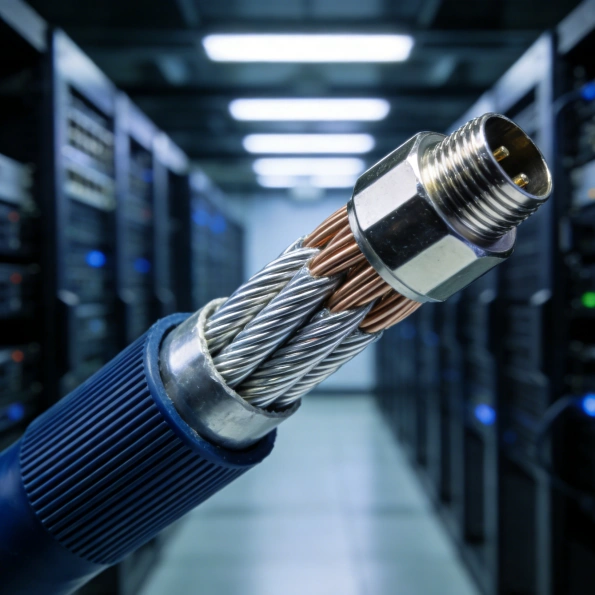
A signal integrity (SI) micro coaxial cable is a miniaturized coaxial cable engineered to preserve signal quality at multi-gigabit data rates. It features a center conductor, dielectric, shielding, and jacket, but is optimized for high-frequency performance, impedance stability, and minimal loss.
Miniaturization: With outer diameters as small as 0.22 mm, they are designed for dense routing.
Precise Construction: The center conductor typically ranges from AWG 30 to 46(0.30 mm to 0.048 mm). A smaller AWG number indicates a thicker conductor.
Controlled Impedance: Most are specified at 50 Ωfor differential high-speed links or 75–90 Ωfor specific RF/analog applications.
Superior Shielding: A continuous outer conductor and often a jacket provide excellent EMI protection and low crosstalk, outperforming FPC/FFC cables in high-speed scenarios.
💻 Why Data Centers Need Micro Coax for High-Speed Links
As data rates climb from 56 Gbps to 112 Gbps PAM4 and beyond, the physics of high-frequency transmission become unforgiving. The signal integrity micro coax cable directly addresses several key challenges in modern data centers:
Overcoming PCB Trace Loss At 56 Gbps PAM4 and higher, PCB traces suffer significant insertion loss. Replacing long PCB traces with short micro-coax jumpers between ASICs, retimers, and connectors drastically reduces loss, especially at frequencies from 10–40+ GHz.
Enabling High-Density, Low-Profile Interconnects To support 400G/800G, ports must be smaller and closer together. Low-profile micro-coax cable assemblies, like the I-PEX CABLINE® series (as thin as 2.0 mm), can be placed under heat sinks near ASICs, enabling more ports per line card and improving airflow.
Maintaining Signal Fidelity SI micro-coax is designed to minimize critical impairments:
Insertion Loss (IL): Minimized through low-loss dielectrics and precise conductor geometry.
Return Loss (RL): Achieved with tight impedance control (e.g., 50 ± 5 Ω).
Crosstalk (NEXT/FEXT): Reduced via excellent shielding and differential pair routing.
Improving Thermal Management Smaller, more flexible cables (e.g., 46 AWG) allow for denser packing and better airflow compared to bulky twinax or bulky coax, which is crucial for thermal management in high-density switches.
Facilitating the Shift to Active Cabling Active micro-coax cables, such as the 112G PAM4 ACC using Spectra7’s GaugeChanger™ technology, use embedded analog chips to boost signals. This allows thinner 46 AWG cables to perform like thicker 36 AWG cables over longer distances, saving up to 90% in power compared to retimed optical solutions.
🔬 Key SI Metrics for Micro Coax in Data Centers
When selecting a micro-coax cable, data center engineers should evaluate the following key performance indicators (KPIs):
Frequency Range & Data Rate Ensure the cable is specified for the target Nyquist frequency (e.g., 28 GHz for 56 Gbps NRZ, 56 GHz for 112 Gbps PAM4).
Insertion Loss (IL) Compare insertion loss versus frequency in dB/length. Lower loss at the target frequency is critical for longer channels.
Return Loss (RL) & VSWR Look for RL better than -15 dB (VSWR < 1.4) at the highest operating frequency to minimize reflections.
Crosstalk (NEXT/FEXT) For multi-pair assemblies, low crosstalk is essential to prevent signal corruption. This is achieved through tight pitch, shielding, and good ground management.
Impedance & Skew The differential impedance should be tightly controlled (e.g., 100 Ω ± 10%). Intra-pair and inter-pair skew must be minimal (e.g., < 5 ps/m) for PAM4 signaling.
EMI Shielding Effectiveness High shielding effectiveness (e.g., >60–80 dB) is necessary to contain noise within the cable and prevent interference with adjacent channels.
Mechanical Robustness Key for high-cycle applications, this includes flex life (bend radius), temperature rating, and crush resistance.
🛠️ Design Best Practices for SI Micro Coax in Data Centers
Match the Medium to the Channel Segment Use micro-coax for the most lossy segments (near ASICs, between boards) and optical or twinax for longer runs between racks.
Optimize the “Last Inch” Pay close attention to the transition from the PCB to the connector. Mismatches here can cause significant reflections. Use connectors with well-defined reference planes and short, controlled stubs.
Manage the Ground Path Ensure a continuous, low-inductance ground path. Use paddle cards or ground fingers in connectors to shorten the return path and push resonance frequencies higher, improving performance at 25–30+ GHz.
Control Bend Radius and Placement Follow manufacturer guidelines for minimum bend radii to avoid impedance discontinuities and increased loss. Keep cables away from sources of interference and mechanical stress.
Simulate Before You Build Use 3D EM tools (e.g., HFSS) to model the entire channel, including cables, connectors, and PCB traces. This helps identify and mitigate impedance mismatches and crosstalk issues early in the design process.
Choose the Right Gauge Don’t default to the thickest cable. For very short, high-density links, a thinner gauge (e.g., 46 AWG) with an active chip can offer the best balance of performance, density, and thermal efficiency.
🚀 The Future: Pushing Beyond 112 Gbps PAM4
The industry is already moving towards 224 Gbps PAM4 for next-generation switches and routers. This will demand even better SI micro-coax solutions, including:
Advanced Materials: New dielectric and conductor materials with lower loss and better thermal stability.
Integrated Active Components: More widespread use of active cables and on-board equalization to extend reach.
Standardization: New connector and cable standards to ensure interoperability and performance at these extreme data rates.
In summary, signal integrity micro coaxial cables are a foundational technology for enabling the next generation of high-speed data center interconnects. By understanding their construction, key performance metrics, and design best practices, engineers can build faster, more reliable, and more efficient data center infrastructure.
Coaxial cables are vital for transmitting high-frequency signals in various applications, from home TV setups to professional communication systems. Proper maintenance and care can significantly extend their lifespan, ensure consistent ...
Definition of Military-Grade Micro Coaxial CablesMilitary-grade micro coaxial cables are miniaturized coaxial cables built to comply with stringent military specifications (e.g., MIL-STD-202, MIL-DTL-17). They typically feature:
...
In industries ranging from aerospace and automotive to industrial automation and telecommunications, Coaxial Cable Assemblies serve as the backbone of reliable signal transmission. Unlike standard cables used in residential settings, th...
In the fast-paced world of electronics development – think cutting-edge medical devices, next-gen aerospace systems, advanced instrumentation, or compact consumer tech – time is critical. Getting your custom micro-coaxial cable prototy...
IntroductionModern electronics operate in increasingly hostile environments—factory floors with EMI from motor drives, automotive engine bays with 150°C temperatures, and satellites exposed to cosmic radiation. Micro-coaxial cables, de...
When selecting micro-coaxial cables for high-temperature applications, understanding the temperature tolerance of PTFE-insulated micro-coaxial cables is critical. Polytetrafluoroethylene (PTFE) is a popular insulation material due...
Micro coaxial cables are essential components in high-frequency signal transmission for industries like telecommunications, medical devices, and consumer electronics. However, their prices can vary significantly depending on multiple va...
Micro coaxial cables are essential in high-frequency applications like telecommunications, medical imaging, aerospace systems, and broadcast equipment. However, long runs face challenges like signal degradation, electromagnetic interfer...
Medical-grade micro coaxial cables are specialized components critical to the function of life-saving and diagnostic equipment like endoscopes, catheters, ultrasound probes, imaging systems, and patient monitoring devices. Unlike standa...
Coaxial cables are indispensable in a wide range of installations, including telecommunications, security systems, broadcasting, and home entertainment setups. However, the one-size-fits-all approach of standard cable lengths often fall...
Keeping micro coaxial connectors (like BNC, SMA, SMB, MCX, MMCX) clean is crucial for strong, reliable signals in cameras, medical devices, test equipment, and communications gear. Dirt, dust, oils, or oxidation can cause fuzzy pictures...
Micro coaxial cables, those incredibly thin cables thinner than a human hair in many cases, are the unsung heroes enabling the high-speed, compact electronics we rely on daily. From 5G smartphones and advanced medical imaging to militar...
Stadiums, as bustling hubs for sports events, concerts, and large-scale gatherings, depend heavily on stable and high-performance communication systems. From real-time video feeds for giant scoreboards to crisp audio for public announce...
Selecting the correct length of coaxial cable assemblies is a critical step in ensuring optimal performance of your electronic systems, whether for telecommunications, broadcasting, surveillance, or industrial applications. Choosing a c...
Coaxial cable assemblies are the backbone of high-frequency communication systems, enabling reliable signal transmission in applications ranging from telecommunications and aerospace to medical devices and industrial automation. Their a...
When lightning strikes nearby or there are sudden power fluctuations, coaxial lines – which are widely used to connect devices like TVs, satellite receivers, and modems – can carry dangerous electrical surges. These surges have the pote...
Micro coaxial cable terminations are the unsung heroes of modern electronics, enabling high-speed data transfer in everything from smartphones to medical devices. Yet, their tiny size makes them highly vulnerable to oxidation, leading ...
The question of whether coaxial cable assemblies can be modified after purchase is a common one among engineers, technicians, and hobbyists who work with RF (radio frequency), video, or data transmission systems. The short answer is: so...
The dream of a quantum internet – enabling ultra-secure communication, powerful distributed quantum computing, and unprecedented scientific discovery – is rapidly taking shape. While quantum processors and photonics capture headli...
Overview and definition
A micro coaxial cable with an I-PEX 20373 connector is a miniaturized, shielded interconnect built to carry high‑speed differential or single‑ended signals between tightly spaced PCBs or modules. The I‑PEX 203...
In the world of concert sound systems, achieving high – quality audio reproduction is of utmost importance. One crucial component that plays a significant role in ensuring excellent sound transmission is the coaxial cable.
Unde...
In the rapidly evolving landscape of medical diagnostics, precision, reliability, and miniaturization have become the cornerstones of technological advancement. Among the countless components that power cutting-edge diagnostic equipment...
In the complex and high-stakes world of military operations, precision targeting is a cornerstone of mission success. Whether it’s a sniper engaging a distant threat, a drone identifying a strategic objective, or an armored vehicle lock...
AbstractMicro-coaxial cables have become indispensable in modern imaging systems, particularly in smartphone cameras and augmented/virtual reality (AR/VR) devices, where high-speed data transfer, space constraints, and signal integrit...
In the complex and high-stakes world of military operations, navigation systems serve as the backbone of strategic decision-making, troop deployment, and mission success. From airborne surveillance platforms to naval vessels and ground-...
In the ever-evolving landscape of electronics, the integration of flexible printed circuits (FPCs) with micro-coaxial cable technology has emerged as a game-changer. This innovative combination brings together the best of both worlds, o...
Imagine a future where downloading full HD movies takes seconds, complex brain scans happen in real-time, and next-gen technologies like AI and the metaverse flow without a stutter. The key? Unleashing unprecedented speed and bandwidth ...
The insatiable demand for bandwidth – driven by 4K/8K streaming, cloud gaming, smart homes, and the proliferation of connected devices – pushes network operators to constantly innovate. While pure Fiber-to-the-Home (FTTH) often grabs he...
IntroductionSpaceX’s ambitious satellite constellations, like Starlink, are revolutionizing global internet connectivity. But behind the scenes, a critical component is driving the success of these mega-constellations: micro-coaxial ca...
Meta Description: Discover how micro-coaxial cables enhance aircraft navigation systems, offering superior signal integrity, EMI shielding, and lightweight solutions for avionics wiring.
IntroductionAircraft navigation syste...
A significant breakthrough has been achieved in the coaxial cable sector with the successful completion of a crucial technical upgrade. This advancement marks a new chapter in the performance and application of coaxial cables, promising...
Introduction
Micro-coaxial cables are vital components in industrial automation, telecommunications, and medical equipment. Proper maintenance ensures signal integrity, reduces downtime, and extends cable lifespan. Follow these pract...
Coaxial cables have been a cornerstone of wired communication systems for decades, prized for their ability to transmit high-frequency signals with minimal interference. From broadcasting and telecommunications to military and aerospace...
High-Frequency Communication & 5G Antenna ModulesMicro coaxial cables are widely used in 5G base stations and mobile devices for high-frequency signal transmission due to their low signal loss, supporting efficient millimeter-wave...
With the continuous advancement of communication technology, the application scenarios of coaxial cables are becoming more and more extensive, and higher requirements are put forward for their installation quality. In response to the ne...
HD video is characterized by its high resolution, vivid colors, and smooth motion. To achieve this level of quality, a large amount of data needs to be transmitted accurately from the source (such as a Blu – ray player, camera, or...
In high-density electronic devices, reliable signal transmission in tight spaces is non-negotiable. That’s why professional buyers turn to a micro coaxial cablesupplier that combines factory-direct pricing, precise customization, and re...
The relentless hum, the powerful thuds, the constant tremors – heavy machinery operates in a world dominated by vibration. While essential for demanding industrial tasks, this vibration poses a silent, pervasive threat to the intricate...
In the high-stakes world of medical training, simulation technology bridges the gap between theory and practice. From intricate surgical simulators to high-fidelity ultrasound trainers, these platforms demand unparalleled accuracy and r...
IntroductionThe High-Temperature Resistant Micro-Coaxial Cable is a cutting-edge connectivity solution engineered to deliver exceptional performance in extreme thermal environments. Combining precision engineering with advanced mate.
KEL’s Micro Coaxial Cable solutions are at the forefront of modern electronic connectivity, offering exceptional performance in high-speed data transmission, miniaturization, and reliability. These connectors are integral to various.
Contact Us Micro Coaxial Cable factory-(FRS).
Feel free to reach out to us for any inquiries or orders