In high-resolution camera modules, displays, and embedded vision systems, the MIPI (Mobile Industry Processor Interface) has become the de facto standard for camera (CSI-2) and display (DSI) interconnects. As resolutions, frame rates, and channel counts increase, the humble micro coaxial cablehas evolved from a simple wiring component into a critical high-speed interconnect that determines image quality, system stability, and EMI compliance.
This article provides an in-depth look at the role of the 90Ω micro coaxial cablein MIPI applications, its electrical and mechanical characteristics, and practical guidelines for selection and design.
Why 90Ω for MIPI?
MIPI D-PHY and C-PHY specifications define the differential impedance of the transmission line, not a single-ended value. The differential impedance of a 90Ω micro coaxial cable is the correct target for a 100Ω differential MIPI pair.
Differential Impedance: The impedance measured between the two conductors of a differential pair.
Single-Ended Impedance: The impedance from one conductor to ground.
For a well-designed differential pair, the relationship is approximately:
Thus, a 100Ω differential target is achieved with a 50Ω single-ended impedance. A 90Ω differential cable is effectively a 45Ω single-ended cable, which is a standard and manufacturable value.
Industry Practice: Many MIPI cable and connector vendors specify their products as “90Ω differential” or “100Ω differential” to match the D-PHY standard. The slight difference between 90Ω and 100Ω is often within the tolerance of the overall channel, especially when considering PCB traces and connector transitions. The key is ensuring the entire channel is impedance-controlled and consistent.
MIPI Speeds and the Need for Micro Coax
MIPI specifications define the following per-lane data rates:
D-PHY: 1.5 Gbps per lane in HS mode (with multi-lane aggregation up to several Gbps total).
C-PHY: Up to 6 Gbps per lane (using a 3-phase encoding scheme).
At these multi-gigabit speeds, even small impedance mismatches, dielectric loss, or crosstalk can cause reflections and degrade the eye diagram, leading to image artifacts like sparkles, flickering, or frame drops.
Why Micro Coax is Essential:
Precise Impedance Control: The coaxial structure (center conductor, dielectric, shield, jacket) allows for tight control over single-ended impedance (typically 45–50Ω), ensuring the differential impedance is close to the 90–100Ω target.
Superior Shielding: Each micro coax pair is individually shielded, drastically reducing crosstalk between adjacent MIPI lanes and protecting against external EMI/RFI.
Controlled Loss: High-frequency dielectric materials (like FEP or PTFE) minimize insertion loss, which is critical for maintaining signal integrity over longer cable lengths.
Mechanical Flexibility: With outer diameters as small as 0.3–0.5 mm, micro coax can be routed through tight spaces and bent without significant performance degradation, unlike stiff FPC/ribbon cables.
Anatomy of a 90Ω Micro Coaxial Cable
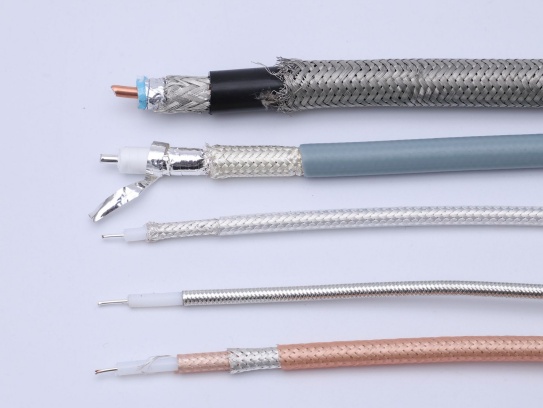
A typical 90Ω micro coaxial cable consists of four main layers:
Center Conductor: Usually silver-plated copper (SPC) or bare copper. A larger diameter lowers resistance but increases capacitance, so a balance is needed for the target impedance.
Dielectric Insulation: This layer defines the single-ended impedance. Materials like foamed PTFE or FEP are common for their low dielectric constant (Dk) and low loss. The dielectric thickness is tightly controlled.
Shielding Layer: Typically a combination of a thin aluminum foil and a tinned copper braid. This dual-layer shield provides >90% coverage for excellent EMI protection and low radiation.
Outer Jacket: A flexible material like PVC or polyurethane that protects the cable from mechanical stress and environmental factors. The choice of jacket affects flexibility, temperature range, and flame retardancy.
Matching the 90Ω Micro Coax to MIPI Connectors
The performance of the entire MIPI channel is only as good as its weakest link. The transition from PCB trace to connector to cable must be seamless.
Connector Impedance: Choose connectors explicitly specified for 90Ω or 100Ω differential impedance. Popular MIPI micro-coax connectors include I-PEX (e.g., CABLINE® series), Hirose, JAE, and others. Mismatched connectors can cause significant reflections.
Connector Geometry: The pad size, via stub, and routing on the PCB must be designed to match the connector’s impedance profile. Poor matching at the connector interface is a common cause of signal integrity issues.
Cable-to-Connector Termination: The shield must be securely grounded to the connector’s backshell, and the center conductor must be precisely crimped or soldered. Inconsistent termination can create impedance discontinuities and skew between channels.
Channel Length, Loss Budget, and Practical Limits
The maximum reliable length of a 90Ω micro coaxial cable for MIPI depends on several factors:
Data Rate per Lane: Higher speeds (e.g., 4–6 Gbps) have less tolerance for loss.
Number of Lanes: More lanes increase overall channel loss and crosstalk.
Cable Construction: Materials and shielding quality directly impact loss and EMI performance.
General Guidelines:
For 1.5 Gbps D-PHY, a well-designed micro-coax cable can often reach 150 mmwithout significant signal degradation.
For 2.5–4 Gbps, lengths are typically limited to 50–100 mm.
Some specialized systems, like certain embedded vision platforms, use high-quality micro-coax to achieve up to 1 meterfor 4-lane MIPI, but this requires careful design and often involves trade-offs.
Loss Budget Analysis: Engineers should perform a channel loss budget that accounts for the PCB trace, connector, and cable losses. If the loss at the target frequency is too high, options include:
Shortening the cable.
Reducing the data rate or number of lanes.
Using a lower-loss cable construction.
Adding active components like a repeater or retimer.
Micro Coax vs. FPC/Ribbon Cables for MIPI
While FPC/ribbon cables are cheaper and easier to mass-produce, they fall short for high-performance MIPI applications.
Feature
90Ω Micro Coaxial Cable
FPC / Ribbon Cable
Impedance Control
Excellent and consistent due to coaxial structure.
Difficult to control precisely over long lengths and multiple layers.
EMI/Crosstalk
Excellent, with individual shielding for each pair.
Poor, with significant crosstalk between adjacent conductors.
Bandwidth
Supports multi-gigabit per lane speeds reliably.
Performance degrades rapidly at high frequencies.
Flexibility
Good for tight-radius bends in 3D spaces.
Can fatigue or crack if bent repeatedly in tight radii.
Best For
High-resolution cameras, long MIPI runs, noisy environments.
Very short connections on rigid PCBs where cost is critical.
🛠️ Design and Manufacturing Considerations
PCB Layout: Maintain symmetry in differential pairs and minimize stubs. Ensure the impedance of the PCB traces matches the cable and connector (typically 45–50Ω single-ended).
Grounding: Use a solid ground plane near the high-speed signals. Connect the shields of all micro-coax cables to a common ground point on the PCB to avoid ground loops.
Channel-to-Channel Matching: For multi-lane MIPI, ensure the electrical length of each lane is matched to within a few millimeters to prevent skew, which can cause color misalignment or image tearing.
Manufacturing Quality: The quality of the cable assembly process is paramount. Variations in shielding termination, crimping, and soldering can ruin the impedance match. Work with vendors who have proven experience in high-speed MIPI cable assemblies.
Applications of 90Ω Micro Coax in MIPI Systems
Mobile Devices: Smartphones, tablets, and AR/VR headsets use micro-coax to connect high-resolution cameras and displays to application processors in ultra-compact spaces.
Automotive: In-vehicle cameras for ADAS and surround-view systems rely on shielded micro-coax to maintain signal integrity in harsh electrical environments.
Industrial & Embedded Vision: Machine vision cameras and inspection systems use micro-coax to carry MIPI signals between sensors and processing units, often in robotic or moving assemblies.
Edge AI & SBCs: Platforms like the NVIDIA Jetson Orin use micro-coax to connect multiple MIPI cameras, where signal integrity is critical for AI inference.
Key Takeaways for Your MIPI Design
When specifying a 90Ω micro coaxial cablefor your MIPI interface, focus on the entire channel, not just the cable itself. Ensure that the PCB, connectors, terminations, and cable are all designed and specified as a system to meet your performance targets for data rate, length, and EMI.
Choosing the right cabling technology isn’t just about raw speed. In demanding environments like factory floors, aerospace systems, military deployments, oil & gas installations, and heavy transportation, cables face extreme c...
As the global rollout of 5G technology accelerates, the demand for reliable, high-performance infrastructure has never been greater. Among the key components powering 5G networks, 5G small cells stand out—they enable dense cov...
In industries ranging from telecommunications and aerospace to medical devices and industrial automation, standard-length coaxial cable assemblies often fail to meet the unique spatial, performance, and integration needs of specific pro...
In the era of smart mobility, precision agriculture, and advanced aerospace systems, satellite navigation has become the backbone of countless critical applications. From guiding commercial aircraft to optimizing farm machinery routes, ...
As robotics technology evolves—from industrial mechanical arms on assembly lines to precision medical robots and agile logistics robots—the cables powering and connecting these machines have become far more than simple “wires.R...
Endoscopes: Enabling High-Definition VisualizationA. Signal Transmission RequirementsEndoscopic cameras and sensors demand ultra-reliable transmission of high-frequency video signals (up to 6 GHz) through tight,弯曲的通道. Micro co...
What is High-Frequency Signal Integrity?Signal integrity refers to the ability of a cable to transmit signals without distortion or degradation. At high frequencies (1 GHz to 100+ GHz), challenges include:
Attenuation: Signal lo...
Overview and definition
Ultra-fine micro coaxial cable with a nominal 0.25 mm outer diameter (OD)is a miniature coaxial interconnect built to carry high‑speed, high‑frequency signals in extremely space‑constrained environments. It pr...
Micro coaxial connectors are essential components in modern electronics, enabling high-frequency signal transmission in compact devices. Here are the most common types:
1. MCX Connectors
Size: 30% smaller than SMB
Frequency: 0...
Coaxial cables are indispensable in telecommunications, broadcasting, and aerospace, where even minor quality flaws can lead to signal loss, system failures, or safety hazards. Hence, strengthening the coaxial cable quality inspection p...
Coaxial cable assemblies are the “nerve system” of audio/video (AV) equipment—they directly determine signal integrity, which in turn impacts picture clarity (e.g., avoiding ghosting or pixelation) and sound fidelity (e.g., ...
In industrial settings, data centers, and even residential electrical systems, managing a network of cables can quickly become a tangled challenge. Without clear identification, tracing a specific cable, troubleshooting issues, or perfo...
Working with micro coaxial cables (common in electronics, drones, cameras, medical devices, and communications) requires precision tools due to their tiny size and delicate construction. Using the wrong tools can easily damage the cable...
Key Differences Between Flexible and Rigid Micro Coax CablesParameter Flexible Micro Coax Rigid Micro CoaxBend Radius 5–10x cable diameter (e.g., 5 mm for 1 mm cable) Fixed shape; no bendingAttenuation Slightly higher due to...
In today’s digital age, coaxial cables serve as the backbone of countless critical systems—from 5G telecommunications and cable TV networks to industrial automation and medical imaging equipment. Their ability to transmit high-frequency...
Micro coaxial cables are essential for transmitting high-frequency signals in compact devices. This guide covers key specifications and customization options to help you choose the right cable for your project.
Diameter & Co...
A groundbreaking marketing campaign for high-performance coaxial cables has concluded with remarkable success, significantly boosting market visibility and driving sales for the featured product line. The campaign, launched by leading c...
Meta Description: Understand critical vibration testing standards (MIL-STD, IEC) for micro coaxial cables. Ensure reliability in aerospace, automotive, medical & consumer tech. Learn requirements here.
H1: What Are the V...
Selecting the correct length of coaxial cable assemblies is a critical step in ensuring optimal performance of your electronic systems, whether for telecommunications, broadcasting, surveillance, or industrial applications. Choosing a c...
Coaxial cable assemblies are critical components in countless applications, from telecommunications and aerospace to medical equipment and industrial automation. Their ability to transmit high-frequency signals with minimal interference...
Proper installation of a coaxial cable is essential to ensure optimal performance, whether it’s for your TV, internet, or other communication systems. A well-installed coaxial cable can minimize signal loss, reduce interference, a...
You push your gaming console hard. Demanding games, fast frame rates, stunning visuals – it all demands immense power, delivered with extreme precision. Hidden deep within your PlayStation, Xbox, or other advanced console lies the unsun...
The global transition toward smart grids is revolutionizing how we generate, distribute, and consume utilities. At the heart of this transformation are Advanced Metering Infrastructure (AMI) systems, commonly known as smart metering sys...
Microwave links play a pivotal role in modern communication systems, enabling high-speed data transmission across long distances without the need for physical fiber-optic cables or terrestrial wiring. From telecommunications networks an...
The demand for miniaturized, high-frequency electronics in applications like 5G, medical implants, and aerospace systems has driven the development of ultra-thin micro-coaxial conductors. However, a critical challenge in these tiny cabl...
As 5G New Radio (NR) networks push into FR2 bands—spanning 24.25 GHz to 40 GHz and beyond—the performance of every interconnect in the RF front-end is under unprecedented scrutiny. Among these, the micro coaxial cable termination soluti...
As the backbone of modern communication infrastructure, coaxial cables are undergoing a significant transformation driven by global environmental regulations and technological innovations. The promotion of eco-friendly materials in coax...
Moisture has long been a nemesis for coaxial cables, causing a range of issues that compromise their performance and longevity. When water infiltrates a coaxial cable, it can lead to signal attenuation, as the water interferes with the ...
In the fast-paced world of smartphone manufacturing, the demand for thinner micro-coaxial cables has become a crucial factor in driving innovation. As consumers continue to seek sleeker, more lightweight devices with enhanced functional...
In the harsh and unforgiving environment of space—where extreme temperatures, intense radiation, and vacuum conditions prevail—reliable signal transmission is critical to the success of satellites, space probes, and orbital stations. Mi...
RF cable assemblies are critical components in telecom infrastructure, enabling reliable signal transmission across networks. From 5G base stations to data centers, these assemblies connect antennas, transceivers, and other equipment, d...
In the high-stakes environment of modern surgery, the endoscope serves as the surgeon’s eyes. As medical technology shifts toward 4K and even 8K resolution, the demand for flawless image transmission has never been higher. While the cam...
Introduction
In semiconductor manufacturing, testing is where billion-dollar investments either prove successful or fail. Ultra-precise micro-coaxial cables serve as the nervous system of these critical testing procedures, ensuring a...
In response to the growing demand for high-performance, specialized coaxial cables in industries such as data centers, broadcast media, and precision security systems, our factory is proud to launch a limited-edition coaxial cable model...
Introduction: The Battlefield Connectivity Imperative
Modern warfare demands unprecedented mobility from soldiers, who routinely carry 15+ kg of electronic gear. Traditional coaxial cables force critical compromises between durabili...
Ever looked at a blurry X-ray or a fuzzy ultrasound and worried about accurate diagnosis? In the high-stakes world of medical imaging, clarity is crucial. One unsung hero powering this precision is the micro-coaxial cable. These tiny ...
In the fast-paced world of live event production, from concerts and sports matches to conferences and theater shows, reliable signal transmission is the backbone of a successful event. Among the various cables used, coaxial cable stands...
IntroductionQuantum computing is no longer a futuristic concept—it’s reshaping industries today. As this groundbreaking technology advances, it demands equally innovative hardware solutions. One surprising area seeing rapid evolution? ...
In the world of outdoor electrical and communication setups, the significance of a reliable cable cannot be overstated. When it comes to harsh weather conditions, outdoor-rated coaxial cables emerge as the go-to solution for a plethora ...
Micro coax cable is widely used in high-frequency signal transmission, but many engineers and buyers still struggle with unstable performance, high loss, and inflexible customization when sourcing from different suppliers. As a professi...
Meta Description: Discover premium RF micro coaxial cables engineered for high-frequency signal transmission in compact devices. Explore specs, applications, and benefits for telecom, medical, and aerospace industries.
.
Meta Description: Discover the advanced features and benefits of Industrial Micro-Coaxial Wiring—engineered for precision, durability, and high-speed signal transmission in industrial environments.
What is Industrial Micro-Co.
Contact Us Micro Coaxial Cable factory-(FRS).
Feel free to reach out to us for any inquiries or orders