Why Data Centers Are Upgrading to High-Density Micro-Coaxial Solutions - Micro Coaxial Cable factory-(FRS)
Micro Coaxial Cable factory-(FRS)
INFO
The relentless demand for faster data, driven by AI, cloud computing, streaming, and 5G, is pushing data centers to their limits. Traditional cabling solutions are struggling to keep pace. This is where High-Density Micro-Coaxial (Micro-Coax) Solutions are stepping in as a critical upgrade path. Here’s why they’re becoming essential:
The Problem: Bandwidth Bottlenecks and Physical Space Crunch
Exploding Bandwidth Needs: Modern servers, GPUs (especially for AI), and networking equipment require immense amounts of data to flow fast. Traditional copper cables (like Cat6A) or older connector types simply hit physical bandwidth limits.
Cable Bulk and Congestion: Standard copper cables used for high speeds (like thick twinax DACs or complex fiber harnesses) take up significant space. In densely packed server racks and switches, this creates:
Airflow Blockage: Thick cables restrict airflow, making cooling harder and less efficient, increasing energy costs and risk of overheating.
Management Nightmares: Bundling and routing bulky cables is time-consuming and difficult, limiting scalability and flexibility.
Physical Space Constraints: There’s only so much room in cable trays, behind racks, and inside patch panels. Thick cables consume valuable real estate needed for more servers or airflow.
The Solution: High-Density Micro-Coax Advantages
Micro-coaxial solutions address these core pain points directly:
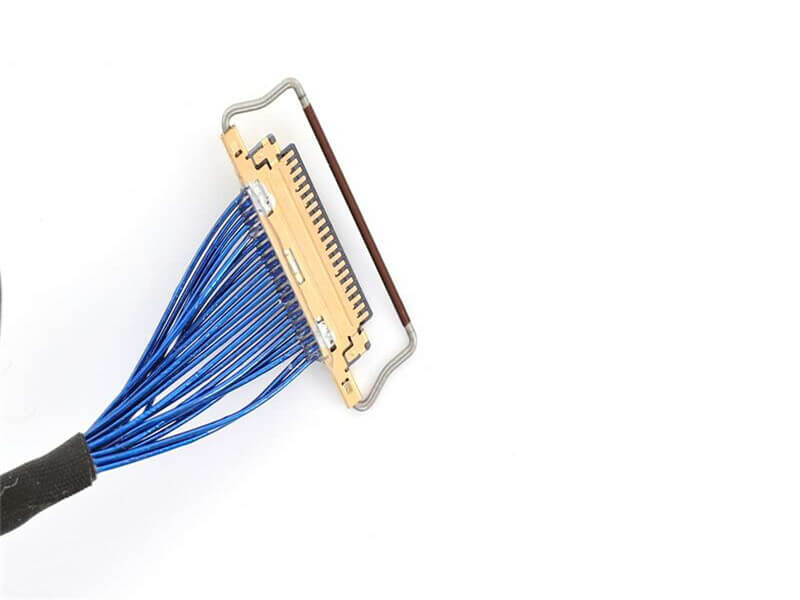
Massive Bandwidth in a Tiny Package: Micro-coax cables consist of multiple miniature coaxial conductors bundled together. Each tiny coaxial channel can carry incredibly high-frequency signals (think tens of GHz) over short distances typical within racks. This translates to multiples of the bandwidth achievable with conventional copper cables in a single, much smaller cable assembly.
Unmatched Density: Because each conductor is so small, many more data channels can fit into a cable bundle the same size (or smaller!) than a traditional copper cable carrying far fewer channels. This dramatically reduces the physical footprint of cabling infrastructure.
More Connections per Panel: Switch and server faceplates can host many more ports.
Clearer Airflow Paths: Significantly thinner and flatter cables block much less airflow, leading to improved cooling efficiency and lower power consumption for cooling systems.
Easier Cable Management: Smaller, lighter cables are far easier to route, bundle, and manage, saving installation time and reducing clutter. This improves serviceability and scalability.
Superior Signal Integrity at High Speeds: Coaxial design inherently provides excellent shielding around each individual signal conductor. This is crucial at ultra-high frequencies where signal degradation (like crosstalk between wires and electromagnetic interference) becomes a major problem for traditional parallel copper cables. Micro-coax maintains cleaner signals, higher fidelity, and lower bit error rates, enabling reliable data transfer at speeds traditional copper struggles with (e.g., 200G, 400G, 800G per lane and beyond).
Cost-Effectiveness (vs. Alternatives):
Compare to Optical Fiber: While fiber handles long distances best, micro-coax provides a significantly more cost-effective solution for short-reach connectionswithin the data center (rack-to-rack, server-to-TOR switch). Active Optical Cables (AOCs) involve expensive electro-optical conversion at each end; micro-coax uses simpler electrical transmission over these short hops.
Compare to Bulkier Copper Alternatives: While the initial cable cost might be comparable or slightly higher than older, bulkier copper assemblies, the reduction in space requirements, cooling costs, and installation complexity often leads to a lower total cost of ownership (TCO).
Direct Component Replacement & Future-Proofing:
Many micro-coax solutions (like those using SFP-DD, QSFP-DD, OSFP, or OSFP-XD connectors) are designed as drop-in replacements for older copper or optical modules/cables. This makes upgrading existing infrastructure smoother.
The inherent bandwidth headroom of the micro-coax medium means these solutions are built for the future. They provide a clear upgrade path to handle next-generation speeds like 1.6T (Terabits per second) as those standards emerge and components become available, protecting your infrastructure investment.
The Bottom Line for Data Centers:
High-Density Micro-Coaxial Solutions aren’t just an incremental upgrade; they are a necessary response to the physical and performance constraints hitting today’s data centers. By delivering massive bandwidth, incredible density, superior signal integrity, easier cooling, simplified management, and a clear path to the future, micro-coax is enabling data centers to keep up with explosive demand without sacrificing reliability or breaking the bank. As speeds continue to climb, micro-coax will be fundamental in connecting the heart of our digital world.
Introduction:Superconducting magnets are revolutionary workhorses powering devices from MRI scanners revealing our inner workings to powerful particle colliders unlocking the universe’s secrets. At their core lies a critical, yet ...
Key Differences Between Flexible and Rigid Micro Coax CablesParameter Flexible Micro Coax Rigid Micro CoaxBend Radius 5–10x cable diameter (e.g., 5 mm for 1 mm cable) Fixed shape; no bendingAttenuation Slightly higher due to...
Coaxial cable assemblies are critical in applications like telecommunications, industrial automation, and aerospace, where faulty parts can disrupt entire systems. Finding the right replacement parts requires precision—here’s a step-by-...
Difficult wire runs present unique challenges in electrical installations, often characterized by tight conduits, multiple bends, extended lengths, or abrasive surfaces. In industrial settings, for instance, wires may need to navigate t...
The short answer is: yes, coaxial cable assemblies (CCAs) are inherently designed to resist environmental interference—but their effectiveness depends on structural design, material selection, and the severity of the operating environme...
The price of coaxial cables varies significantly across different models, influenced by design specifications, performance capabilities, and application requirements. Understanding these differences helps users make cost-effective decis...
5G technology promises incredible speed, massive capacity, and ultra-low latency. To deliver on this promise, especially for mid-band and crucially for high-band (millimeter wave or mmWave) frequencies, network operators are deploying v...
When working with coaxial cable assemblies, one of the most common questions engineers, technicians, and procurement professionals ask is: “Are coaxial cable assemblies compatible with all connector types?” The short answer is no—compat...
Cable glands, often referred to as cable connectors or cable fittings, are critical components in electrical and mechanical systems, designed to create a secure, environmental seal where cables enter enclosures, equipment, or junction b...
In the era of miniaturized electronics and high-speed data transmission, micro coaxial cables have emerged as a critical component for applications requiring reliable signal integrity in compact spaces. These cables are a specialized ...
Micro coaxial cable is a miniaturized coaxial interconnect built to carry high‑speed, high‑frequency signals in extremely confined spaces. Each conductor is surrounded by a precise dielectric and a continuous outer shield, enabling tigh...
In the global landscape of technological advancement, emerging markets are emerging as powerful engines of growth, driving demand for high – quality infrastructure and electronic components. Among these, coaxial cable, a vital ele...
In today’s interconnected world, electronic devices and systems rely on stable signal transmission to function effectively. However, electromagnetic interference (EMI)—unwanted electrical or magnetic energy that disrupts signal integrit...
In the world of electronics and telecommunications, coaxial cables play a pivotal role in transmitting signals. One of the most crucial aspects of coaxial cables is their impedance. Understanding coaxial cable impedance is essential for...
Micro-coaxial power lines pack impressive power transfer into tiny spaces. But pushing high voltages through these miniature channels creates a critical challenge: preventing dangerous electrical discharges and ensuring safe, reliable ...
In the complex web of modern electronics and communication systems, signal integrity is the backbone of reliable performance. From the data centers powering global networks to the medical devices monitoring vital signs, and from aerospa...
Micro coaxial cables are vital components in modern electronics, connecting everything from high-resolution cameras in smartphones to intricate sensors in medical devices. Because they carry critical high-frequency signals, a counterfei...
Micro coaxial cable is a critical component for high-frequency, high-density connections in modern electronics. This guide answers common questions and provides a practical roadmap for selecting the right cable for your application.
...
The latest global coaxial cable market research report has been officially released, providing comprehensive insights into the industry’s current landscape and future trajectory. As connectivity demands continue to surge across te...
Coaxial cables have played a pivotal role in the evolution of network communication systems. Among them, Thicknet (Thick coaxial cable) and Thinnet (Thin coaxial cable) were widely used in early Ethernet implementations, particularl...
Choosing the right cable for your project can be confusing, especially when faced with terms like “micro coaxial” and “standard coaxial.” While both transmit signals efficiently, they serve very different purpose...
In the realm of modern connectivity, long-distance cable runs are a fundamental aspect of various industries, from telecommunications and networking to audio-visual setups. However, as signals travel over extended cable lengths, they en...
In the world of electrical and electronic systems, coax connectors play a pivotal role. They are the unsung heroes that ensure seamless signal transmission, whether it’s in a high – tech telecommunications setup, a complex i...
In the realm of modern communication, industrial automation, and even residential signal transmission, coaxial cables stand as the unsung heroes that ensure stable and efficient data, audio, and video signal delivery. Among the numerous...
As 5G New Radio (NR) networks push into FR2 bands—spanning 24.25 GHz to 40 GHz and beyond—the performance of every interconnect in the RF front-end is under unprecedented scrutiny. Among these, the micro coaxial cable termination soluti...
Recently, our factory’s high-performance coaxial cable has been officially selected as a featured exhibit for the upcoming Shanghai International Industry Expo (SIIE) — a pivotal event that gathers top industrial brands, tech innovators...
As the Internet of Things (IoT) evolves from a niche concept to a global infrastructure, the demand for smaller, more reliable, and high-performance components has never been greater. Among these critical components, micro-coaxial cable...
Modern vehicles are evolving into complex networks of sensors and high-speed data links. At the heart of this transformation is the anti-interference micro coaxial cable, a critical component for ensuring the reliable operation of Advan...
In the high-precision world of manufacturing micro-coaxial cables for critical applications (5G, medical devices, aerospace, consumer electronics), every millimeter counts. These cables, often incorporating expensive materials like silv...
In today’s hyper-connected world, coaxial cables remain the backbone of reliable signal transmission across industries—from telecommunications and broadcasting to data centers and home entertainment. As technology evolves, so do the dem...
In the realm of wireless communication, wireless base stations serve as the vital hubs connecting devices to networks. And among the key components ensuring their smooth operation, coaxial cables play an indispensable role. This article...
In the dynamic world of modern manufacturing, multi-robot assembly lines represent the pinnacle of efficiency, speed, and precision. These complex systems, where multiple robotic arms collaborate seamlessly, demand flawless communicatio...
[City, Country – Date]– As high-speed interconnects continue to shrink in size, signal integrity and electromagnetic compatibility (EMC) are becoming critical design challenges. To address this, FRShas officially introduced new shieldin...
The short answer is: Yes, coaxial cable assemblies are not only compatible with 5G network devices but also play a critical role in 5G signal transmission—provided they meet 5G’s unique technical requirements. Unlike 4G, 5G relies on hi...
The evolution of VR and AR headsets is driven by a constant push for higher resolutions (4K/8K per eye), faster refresh rates (90–120 Hz+), and sleeker, lighter designs. This progression places immense pressure on internal high-speed in...
If you’re working with RF (radio frequency) systems, antennas, or small-scale electronics, chances are you’ve encountered RG-174 micro-coaxial cables. These thin, flexible cables are popular for their low loss and durability in tight s...
Fundamentals of Bend Radius in Micro-Coaxial CablesA. Definition of Bend RadiusThe minimum bend radius (MBR) is the smallest allowable curvature a cable can withstand without permanent deformation or electrical performance degrad...
Introduction
The miniaturization of electronic devices demands precision in micro-coaxial cable design, where traditional methods face bottlenecks in efficiency and performance prediction. AI-powered tools are revolutionizing this ni...
In the realm of communication and electronics, coaxial cables stand as indispensable components, with their quality directly impacting the performance of entire systems. Today, a groundbreaking development has emerged: the quality compl...
Coaxial cables are indispensable components in numerous systems, ranging from communication networks to home entertainment setups, as they play a vital role in transmitting signals stably and efficiently. To ensure their long-term relia...
Overview of I-PEX Micro Coaxial Cable Connectors
I-PEX is a global leader in micro coaxial cable solutions, specializing in high-performance IPEX micro coax connectors and micro coaxial cable assemblies. These products are designed for.
Meta Description: Discover premium RF micro coaxial cables engineered for high-frequency signal transmission in compact devices. Explore specs, applications, and benefits for telecom, medical, and aerospace industries.
.
Contact Us Micro Coaxial Cable factory-(FRS).
Feel free to reach out to us for any inquiries or orders