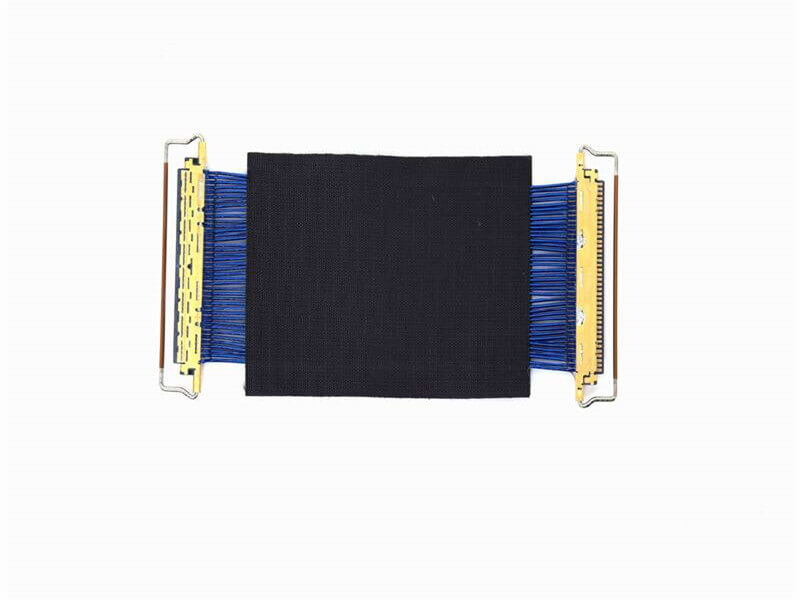
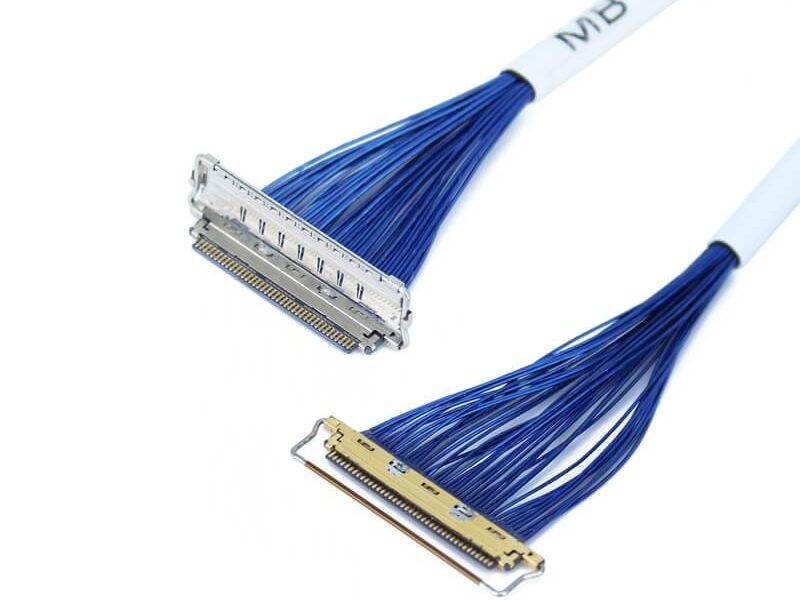
Micro coaxial cable with PTFE (polytetrafluoroethylene) insulation is a high-performance interconnect solution designed for applications where space is limited, signal integrity is critical, and environmental conditions are demanding. It features an extremely small diameter, a precisely controlled characteristic impedance (typically 50 Ω), and a dielectric layer made of PTFE or PTFE-based materials.
🔬 Key Characteristics
- Miniaturization: With finished diameters as small as 0.5–1.0 mm, these cables are ideal for routing through tight spaces like medical device handles, endoscopic tools, and compact electronic devices.
- Precise Impedance: A uniform PTFE dielectric ensures a stable 50 Ω impedance, which is essential for preventing signal reflections and maintaining signal fidelity in high-frequency circuits.
- Superior Electrical Performance: PTFE’s low and stable dielectric constant (εr ≈ 2.0–2.1) and extremely low dissipation factor (tan δ < 0.0003) result in minimal signal loss (attenuation) and phase distortion, even at microwave and millimeter-wave frequencies.
- Robust Mechanical & Environmental Properties: PTFE is naturally flexible and maintains this flexibility across a wide temperature range (-55 °C to +200 °C+). It is also highly resistant to chemicals and moisture, making it suitable for harsh environments.
💡 Why Choose PTFE Insulation?
The choice of PTFE as the dielectric material is driven by several key performance advantages:
- Ultra-Low Loss for High Frequencies PTFE’s low permittivity and loss tangent directly reduce signal attenuation. This is critical for high-frequency applications (hundreds of MHz to tens of GHz), where even small losses can degrade signal quality. Micro-coax cables with PTFE insulation are widely used in RF test leads, 5G infrastructure, and phased-array radar systems.
- Excellent Phase Stability PTFE’s stable dielectric properties across temperature and frequency ensure minimal phase drift. This is vital for systems requiring precise timing or beamforming, such as 5G base stations and satellite communications, where phase-matched cables are essential.
- Wide Temperature Range & Flexibility PTFE remains flexible at cryogenic temperatures and stable at high ones, unlike many other polymers. Micro-coax cables with PTFE insulation are specified for use from -55 °C to +200 °C, making them suitable for aerospace, automotive, and industrial applications.
- Chemical & Moisture Resistance PTFE is highly inert and hydrophobic, resisting degradation from exposure to acids, bases, and solvents. This makes it ideal for medical devices that undergo repeated sterilization and for industrial equipment in corrosive environments.
- Low Outgassing for High-Vacuum Environments PTFE’s minimal outgassing is a significant advantage in high-vacuum or cleanroom settings (e.g., space instruments, semiconductor equipment), where contamination from volatiles must be avoided.
- Mature Manufacturing & Availability PTFE and its variants (like FEP, PFA, ePTFE) are available in various forms (solid, foam, tape) and are produced to tight tolerances, supporting high-volume manufacturing of reliable micro-coax cables.
🏗️ Typical Construction
A micro coaxial cable with PTFE insulation typically features the following layered structure:
- Center Conductor: A very fine wire, often silver-plated copper, copper-clad steel, or镀银铜包钢, chosen for its high strength and conductivity at high frequencies.
- Dielectric Insulation: The core of the cable, made of PTFE, ePTFE (expanded PTFE), or PTFE foam. This layer determines the cable’s impedance and electrical performance.
- Inner Shield: A thin layer of aluminum/polymer tape or a fine conductive coating applied directly over the dielectric to contain the electric field.
- Outer Shield: A braided layer of tinned or silver-plated copper wires, providing 80-95% coverage to protect against electromagnetic interference (EMI).
- Jacket (Optional): An outer layer of FEP, PFA, or PVC that provides mechanical protection, chemical resistance, and color-coding.
🎯 Key Application Areas
- Medical & Biomedical Devices Used in endoscopes, surgical robots, and imaging probes where small size, flexibility, and reliable signal transmission in sterilizable environments are paramount.
- Test & Measurement Equipment Essential for VNA test leads, oscilloscope probes, and RF interconnections in ATE (Automated Test Equipment) where low loss and phase stability are critical.
- 5G, Telecom & RF Communications Employed in base station jumpers, antenna feeds, and other RF interconnections requiring low loss and high reliability in compact spaces.
- Aerospace, Defense & Space Used in avionics, radar systems, and satellites due to their ability to perform reliably in extreme temperatures and high-vacuum conditions.
- Industrial & Harsh-Environment Electronics Suitable for downhole tools, robotic cables, and sensors in chemical plants where resistance to heat, chemicals, and abrasion is required.
✅ How to Select the Right Cable
When choosing a micro coaxial cable with PTFE insulation, consider the following factors:
- Frequency & Data Rate: Higher frequencies demand lower dielectric loss. PTFE and ePTFE are preferred for GHz+ applications.
- Impedance Matching: Ensure the cable’s impedance (usually 50 Ω) matches the source, load, and connectors to minimize reflections.
- Bend Radius & Flex Life: For moving parts, select a cable with a small bend radius and high flex life. ePTFE and foamed PTFE offer better flexibility.
- Environmental Conditions: Consider the operating temperature, potential chemical exposure, and the need for vacuum compatibility.
- Shielding Effectiveness: For noisy environments, opt for cables with high braid coverage and dual shielding (tape + braid).
- Connector Compatibility: The cable’s dimensions and dielectric must be compatible with the chosen connector to ensure a reliable termination.